Notification fatigue
Desensitisation and exhaustion from constant interruptions.
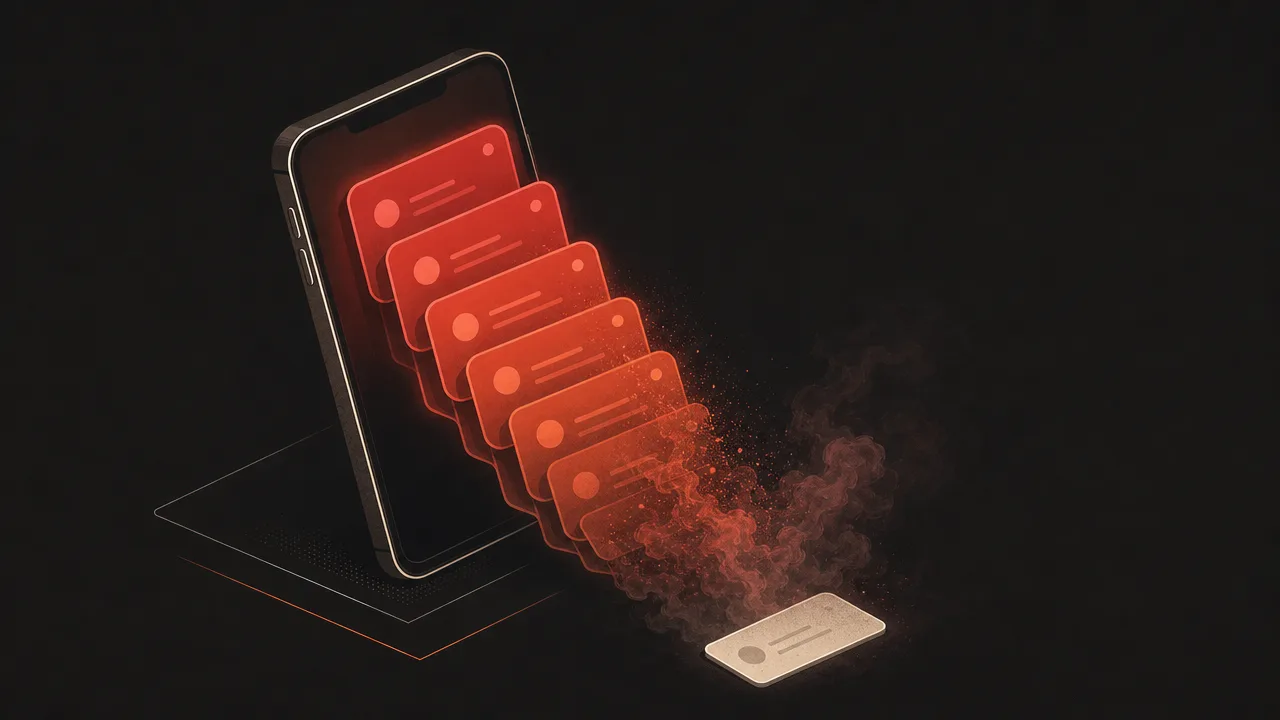
Notification fatigue describes what happens when a person is exposed to so many alerts that the alerts stop working. Pings, badges, banners, emails, and chat mentions blur into a single background hum, and the recipient starts dismissing them without reading, ignoring them entirely, or disengaging from the apps that send them. The term is borrowed from a much older and more serious problem in healthcare, where it is usually called alarm fatigue, and it has been studied for decades in that setting.
This page covers what notification fatigue is, where the concept came from, how it shows up in everyday digital work, the benchmarks that exist (with the caveat that good ones are scarce), and how it relates to the wider family of attention metrics in this encyclopedia.
What is notification fatigue?
Notification fatigue is the state in which a person no longer reliably responds to incoming alerts because the alerts have become too frequent, too undifferentiated, or too often irrelevant. It has two components: desensitisation, the psychological response in which repeated exposure to a stimulus reduces the reaction to it, and exhaustion, the cumulative cognitive cost of repeatedly switching attention to evaluate whether each new ping is worth acting on.
The concept did not start with smartphones. It originated in the medical-alarm literature, where clinicians in intensive-care units and operating theatres were observed to ignore, silence, or adjust alarms that had become near-continuous. The Joint Commission's Sentinel Event Alert 50, published in April 2013, formalised the problem and described how clinicians become "desensitised or immune to the sounds and overwhelmed by all the information" when faced with hundreds of alarms per patient per day. The same vocabulary now applies to push notifications, chat mentions, email alerts, and incident pages: a high volume of mostly low-value signals that gradually trains the recipient to ignore the channel.
Why does notification fatigue matter?
The first reason is that ignored alerts are still alerts. Each interruption pulls attention, even briefly, and leaves attention residue that lingers after the alert has been dismissed. A workday composed of a continuous stream of small dismissals is not the same as a workday with no alerts, even if the apparent productivity numbers look similar.
The second reason is that important signals get lost in the noise. ECRI Institute has consistently ranked alarm hazards among the top health-technology hazards since 2011. In digital work the equivalent is missing the message that actually needed a response, paging a colleague who no longer reacts to pages, or failing to notice an outage because the on-call channel has been muted out of self-defence.
The third reason is that notification fatigue erodes the contract between user and tool. Once a user has learned that an app's notifications are mostly worth ignoring, that learning is hard to undo. The channel is effectively burned, and mobile-analytics vendors report that disabling notifications often precedes uninstalling the app entirely.
How is notification fatigue identified?
There is no single accepted measurement of notification fatigue. Researchers and product teams typically triangulate from a small set of signals.
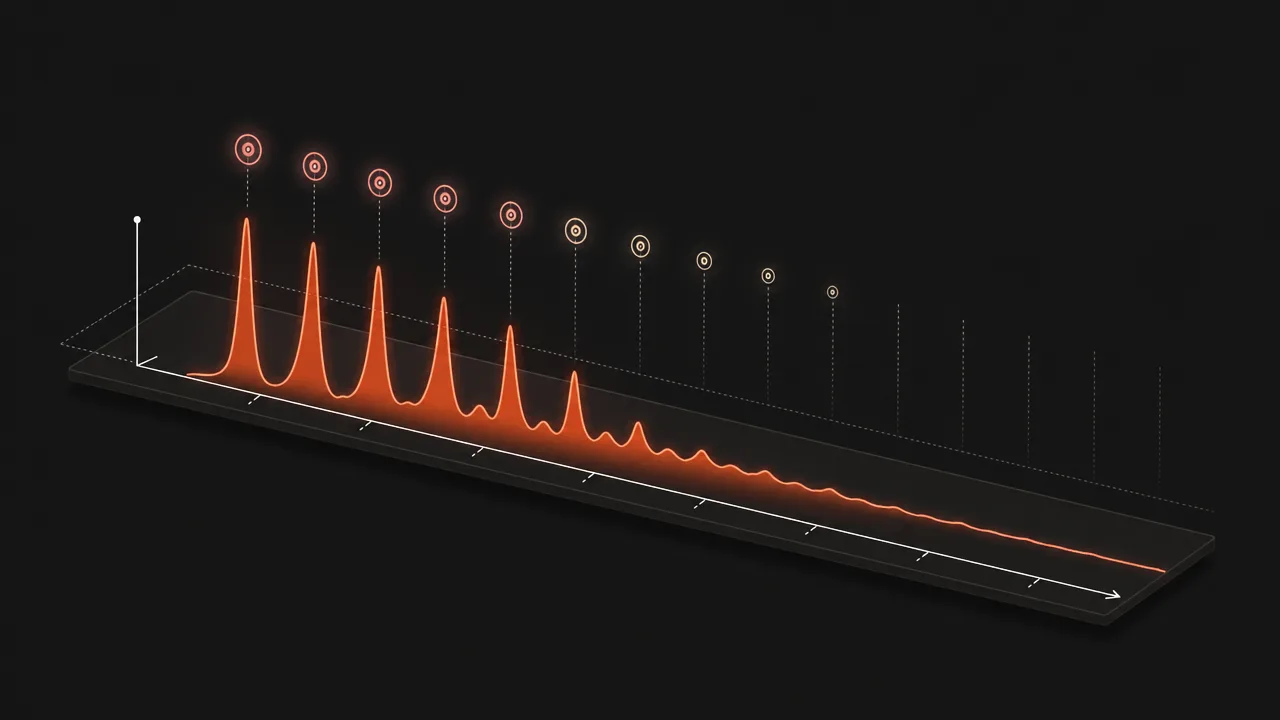
Volume is the simplest. The raw count of notifications received per day, per app, or per channel provides a baseline. On its own it does not prove fatigue, but very high volumes are a strong precondition. Closer to the phenomenon itself is the dismissal-without-action rate: notifications swiped away, marked read, or cleared in bulk without the user opening the underlying message. Ignore-then-engage cycles, in which alerts are ignored for hours and then handled in a burst, are another behavioural fingerprint.
Behavioural signals are typically supplemented with surveys. Self-report instruments adapted from the clinical alarm-fatigue literature ask respondents about feeling overwhelmed by alerts, distrusting their meaning, or disabling them in order to cope. These instruments are subjective but they capture the experiential side of fatigue that pure volume counts cannot.
Common benchmarks
Benchmarks for notification fatigue are uneven. Healthcare has the longest and most rigorous body of work; consumer and workplace figures are more often industry reports than peer-reviewed studies. The most commonly cited reference points are:
- In the Joint Commission's Sentinel Event Alert 50 (2013), an estimated 85% to 99% of medical-device alarm signals were reported as not requiring clinical intervention, producing the desensitisation now called alarm fatigue.
- ECRI Institute's analyses of monitor alarms have placed the share of false or clinically insignificant alarms in a similar range, roughly 80% to over 99% depending on the device and setting.
- The Joint Commission reported 98 alarm-related events in its sentinel-event database between January 2009 and June 2012, of which 80 resulted in death, 13 in permanent loss of function, and 5 in additional care or extended stay.
- Industry summaries of mobile-analytics data describe the average smartphone user as receiving roughly 46 to 64 push notifications per day across all installed apps. These are vendor-reported figures rather than peer-reviewed research, and they should be read as order-of-magnitude indicators.
- A 2023 Common Sense Media study of US teenagers reported a median of approximately 237 notifications per participant per day, with substantial variation and a notable share arriving during school hours and overnight.
- Industry write-ups of workplace messaging have placed average daily Slack message volume per active user at roughly the high tens to low hundreds, with users checking the platform multiple times per hour during the workday. The peer-reviewed evidence on workplace messaging volume is much thinner than these vendor figures suggest.
Where authoritative numbers are missing, it is more honest to describe a pattern than to invent a threshold. The pattern is consistent across settings: a small share of alerts genuinely require action, the rest accumulate as background noise, and the recipient eventually adapts by ignoring the channel.
Examples
A few worked examples illustrate how notification fatigue shows up in different settings.
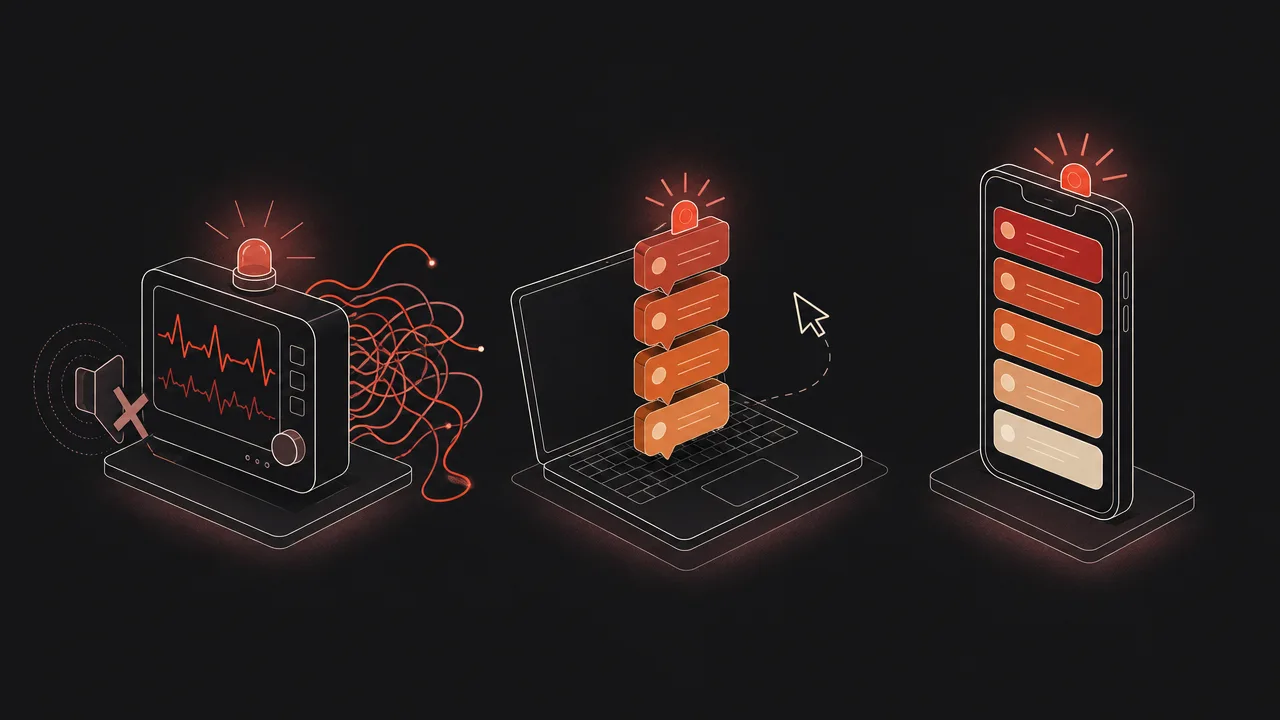
A nurse on a cardiac step-down unit hears continuous beeping from monitors across a six-bed bay. Most alarms are triggered by patient movement, loose leads, or thresholds set too tightly. After a few shifts the nurse stops looking up for each one. When a genuine arrhythmia alarm sounds it is initially treated as part of the same background, which is exactly the failure mode described in the Joint Commission's 2013 alert.
A software engineer on call receives roughly forty alerts per week from the incident-management system. Around 90% are flapping checks, noisy thresholds, or alerts that auto-resolve before anyone looks at them. The engineer learns to acknowledge alerts in batches. When a real production incident arrives during a quiet hour the response is slower than the team's stated targets, not because anyone is negligent but because the channel has been trained to be ignored.
A marketing manager keeps a phone on the desk with notifications enabled for email, chat, calendar, and several social apps. By mid-afternoon the manager is clearing notifications in groups without reading them, then in the evening notices a missed message from a client that had been waiting for hours. The volume is unremarkable by current industry figures; the effect on the manager's attention is not.
Misconceptions
The first misconception is that notification fatigue is just annoyance. Annoyance is the surface symptom. The underlying problem is a measurable shift in responsiveness: real signals are missed, response times increase, and trust in the channel erodes. The clinical literature is unambiguous that these effects have produced fatal outcomes; the office equivalents are less severe but they are not merely a mood.
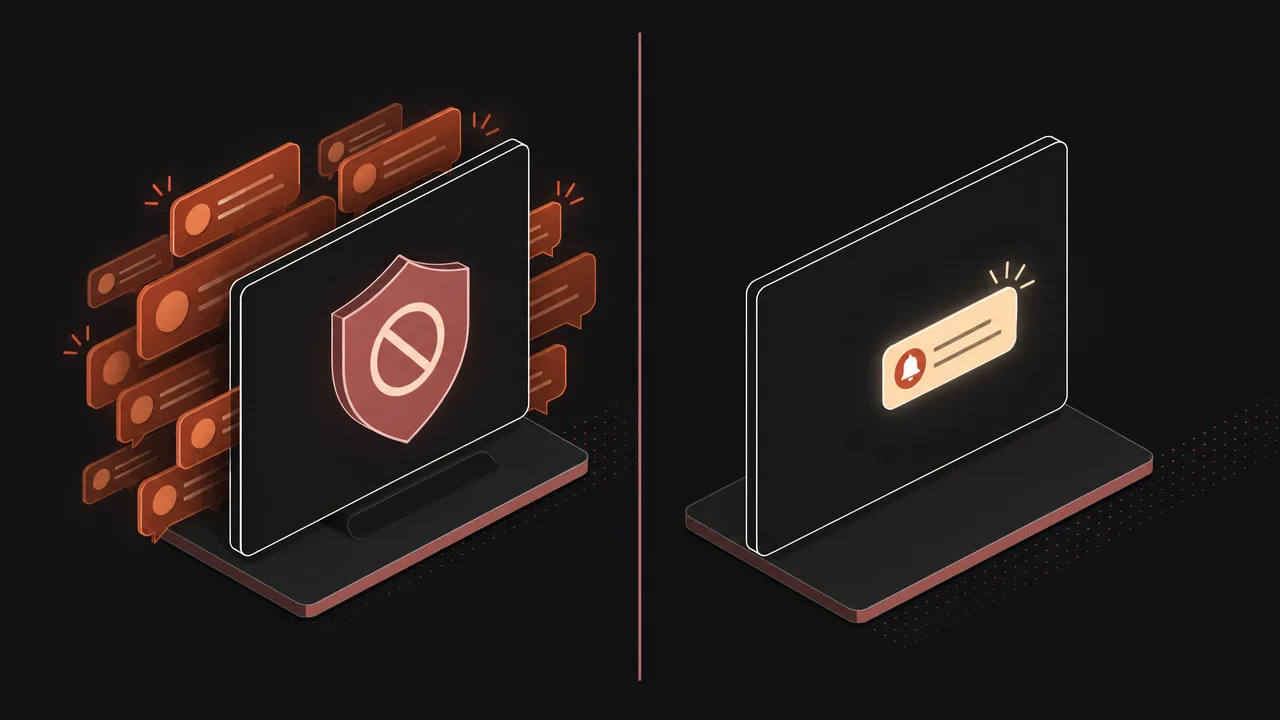
The second misconception is that all notifications are bad. They are not. A notification that arrives at the right time, contains the right information, and concerns something the recipient cares about is one of the most useful affordances in modern software. The fatigue comes from the gap between that ideal and the everyday reality of broadcast alerts, marketing pings, and noisy automated systems.
The third misconception is that "important only" filters reliably solve the problem. They help, but they can backfire. If the filter is generous, the user has merely shifted the fatigue to a smaller bucket. If the filter is strict and important messages get blocked, the user starts checking the muted channel "just in case", which reintroduces the cognitive cost the filter was supposed to eliminate. Effective filters tend to be combined with explicit response-time agreements and a genuine reduction in upstream volume.
Related concepts
Notification fatigue sits in the middle of a small cluster of attention concepts. Understanding it well usually means understanding the others.
- Digital overload: the broader state of having too much incoming information across all channels.
- Context switching: the act of moving attention between tasks or applications, which notifications often trigger.
- Attention residue: the lingering mental occupation with a previous task after switching away from it.
- Focus fragmentation: the breaking of continuous focus time into short, interrupted segments.
- Doomscrolling: compulsive scrolling through distressing content, often driven by app notifications.
- Deep work: the extended uninterrupted focus that notification fatigue most directly undermines.
- Workday fragmentation: the structural shape of a day composed of many short segments rather than long blocks.
- Screen fatigue: the physical and cognitive tiredness from sustained screen use, often correlated with high alert volume.
- Application switching: the foreground-application changes that often accompany incoming notifications.
Tracking notification fatigue
Notification fatigue itself is not a metric. It is a state inferred from several signals, most of which a computer-activity tracker is well placed to surface. WhatPulse runs locally on Windows, macOS, and Linux and records active time, application switching, foreground-application sequences, and input activity. Together these readings paint a recognisable picture of a day shaped by interruptions.
The most useful indirect signal is the rate and pattern of application switching. A workday with frequent short visits to a chat or mail client, especially when those visits interrupt longer sessions elsewhere, is the behavioural fingerprint of an alert-driven workflow. Over weeks and months, trend data shows whether the pattern is improving or worsening, which is harder to judge in the moment. The point is to make the shape of the day visible, so that users can act on it through notification settings, channel memberships, or working agreements with colleagues, rather than noticing the fatigue only after it has caused harm.
Frequently asked questions
Is notification fatigue the same as alarm fatigue?
Alarm fatigue is the original clinical term, used to describe how hospital staff stop responding to medical-device alarms when most of them turn out to be false. Notification fatigue is the broader digital descendant of that concept, covering push notifications, chat pings, email alerts, and other interruptions.
How many notifications per day count as too many?
There is no fixed threshold. Industry summaries describe average smartphone users receiving in the range of 46 to 64 push notifications per day across all apps, and surveys of teenagers report substantially higher counts. The relevant question is usually not raw volume but how many of those notifications you act on versus dismiss.
Does turning off notifications fix the problem?
It reduces the immediate interruption load, which usually helps. It does not address the underlying expectation, often imposed by colleagues or platforms, that you respond quickly. Sustainable relief tends to require both fewer alerts and clearer agreements about response times.
Why do I feel anxious when notifications stop?
After long exposure to frequent alerts, the absence of notifications can register as a problem to be checked rather than a relief. This is sometimes called phantom-notification anxiety. It usually subsides over days to weeks once the underlying alert volume comes down.
Are "important only" filters a reliable fix?
They help, but they can backfire. If too many notifications get classified as important, the filter becomes another full inbox. If too few do, you can miss things that genuinely needed attention. Filters work best alongside reduced overall volume rather than as the only intervention.
Does notification fatigue cause real harm or just annoyance?
In clinical settings, alarm fatigue has been linked to patient deaths when staff disabled or ignored alarms that later turned out to be real. The Joint Commission reported 98 alarm-related events in its sentinel database between January 2009 and June 2012, with 80 resulting in death. In digital work, the harm is usually subtler and shows up as missed messages, slower response to genuine emergencies, and chronic cognitive load.
How long does it take to recover from notification fatigue?
There is no clean answer in the research literature. Anecdotal accounts and habit-formation studies suggest that the worst symptoms ease within a few weeks of substantial reduction in alert volume, although the underlying habit of checking can take longer to fade.
Conclusion
Notification fatigue is a precise idea inherited from a serious clinical problem. It describes the desensitisation and exhaustion that follow from too many alerts, too often irrelevant. The healthcare literature, the Joint Commission's 2013 alert, and ECRI's continuing top-hazard rankings have established that the effects are real and, in clinical settings, sometimes fatal. The digital equivalents are quieter, but they shape modern attention in ways that show up in switching patterns, response times, and the slow erosion of trust in the channels that are supposed to convey what matters. Treated as a state to be monitored rather than a single number to optimise, it is one of the more useful lenses through which to read a long record of computer activity.