What's new with WhatPulse?
WhatPulse 7.0
WhatPulse 7.0 is the biggest change under the hood since the app was first written. Counting now happens in its own background process, separate from the window you interact with. On top of that: a new sidebar navigation, a built-in feedback window, league standings on the Overview page, a universal macOS build, a big round of Linux improvements, and a long list of fixes. Let's dig in.
Counting and the window are now separate
WhatPulse is now two parts: a small background collector that counts your keys, clicks, uptime and network traffic, and the app window you already know. The collector starts at login and keeps counting on its own, so closing, restarting or even crashing the window never interrupts your stats. Heavy work in the collector, like counting a lot of network packets, can no longer slow down the interface. Quitting from the tray still stops everything, and if the collector ever stops unexpectedly, the app restarts it for you.
macOS: because the collector is a new program, macOS asks you once to allow Input Monitoring and Accessibility for it after updating. WhatPulse guides you through it and keeps counting uptime and network traffic in the meantime.
Linux: if you used setcap to allow network capture, grant it to whatpulse-collector instead.
New sidebar navigation
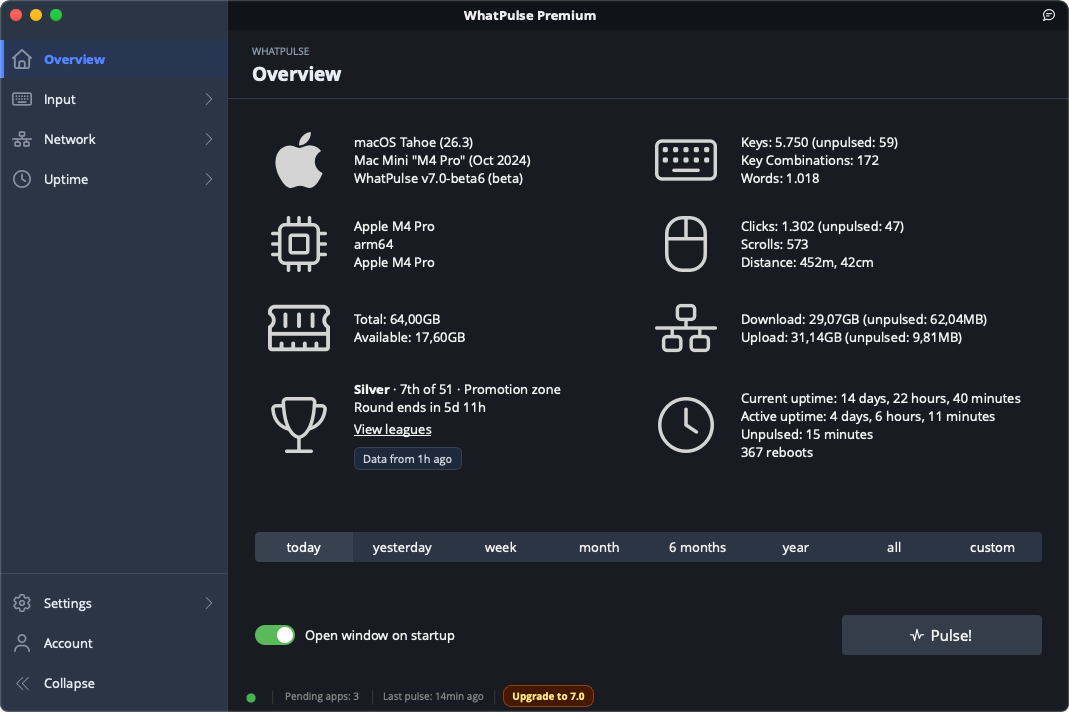
The top navigation bar and the per-page tabs are replaced by one sidebar with every page and sub-page in it. Collapse it to a slim icon rail and hover to reveal sub-pages. Prefer the old layout? Switch back under Settings > Appearance > Navigation.
League standings
When you're in the Leagues, the Overview page shows your division, rank, zone and the time left in the round. Click it to open the full leaderboard. The Geek Window gets matching league variables.
Send feedback from inside the app
A new feedback icon in the title bar lets you report a problem, suggest a feature or send other feedback. Problem reports can attach your logs and statistics database so we can see what went wrong.
Better application recognition
Apps with generic names like game.exe are no longer merged together online. WhatPulse now also sends the app's publisher (Windows), developer Team ID (macOS) and store ID for games from Steam, Epic, GOG and the Microsoft Store.
Cleaner window title lists
Titles that change constantly, like FPS counters, media timestamps, download percentages and unread badges, are now collapsed into one entry. A background cleanup tidies up titles recorded before this update.
A fresh look
One consistent icon set across the whole app, and an installer that follows your system's light or dark mode. Plus it's prettier.
Platforms
- macOS: one universal build for Intel and Apple Silicon, with a native installer and updater.
- Windows: Launch when computer starts is always available again and follows the Startup apps toggle in Task Manager. Rounded window corners on Windows 10.
- Linux: AppImage updates now install and restart properly, Flatpak works on KDE Plasma and GNOME, IPv6 traffic and native Wayland apps are attributed correctly, sleep is detected, and processors and graphics cards show up.
Accessibility
The tray popup now works fully with the keyboard and screen readers. On macOS, right-clicking the tray icon opens a native menu with Pause/Resume tracking. The interface has been fully tested with VoiceOver and NVDA.
Fixes
- Fixed the mouse heatmap "Prune older than 3 months" setting deleting old data even when turned off.
- Fixed the tray popup's Today and Week views counting everything since your last pulse twice.
- Fixed deleted profiles being counted twice in the combined view. Existing duplicates are repaired automatically.
- Total uptime now only counts time WhatPulse measured, so a wrong system date can no longer inflate it.
- Fixed Geek Window labels disappearing or overwriting each other after adding them.
- Network traffic is attributed correctly on machines with multiple network adapters and on IPv4/IPv6 dual-stack connections.
- Many crash fixes, in the heatmaps, input capture, the Geek Window and during shutdown.
- Crash reporting now covers macOS and Linux too, and never includes what you type, window titles or app names.
Your profile, redesigned
Your WhatPulse profile page has been rebuilt to show off your stats. Your weekly activity, rankings and newest badges are now at the top, along with how you're doing in this week's league round, including your division, rank and recent form.
Live numbers in your bio now stand out, so visitors can see what's real-time. Hover over a number to see which variable it comes from. Add a few to your bio and it updates itself every time you pulse.
The new Share button sends your profile to friends straight from your phone or browser, or copies the link in one click. Open your profile, check it out, and show everyone what your keyboard has been up to!
WhatPulse Leagues are here!
Your keys and clicks now put you into a fresh competition every week. You'll compete in a group of roughly 50 active users, starting in Bronze and working your way through eight divisions all the way to Legend. Finish near the top to get promoted, stay safely in the middle, or risk relegation at the bottom.
Your normal WhatPulse activity is all that counts - no timers or extra tracking. Every Monday brings a new group and scores start back at zero, while Friday's final sprint hides your rivals' scores for the last stretch of the competition. Head to Dashboard → Leaderboards → Leagues to meet your first opponents. See you in Bronze!
WhatPulse 6.3.2
Changes
- Updated Russian translation, thanks to Minto Hoshikawa
- Fixed the "today" stats values in the tray menu. For some people, it was including the unpulsed stats.
WhatPulse 6.3.1
A small follow-up release to 6.3 with a few bug fixes and interface improvements.
Scroll counting fixes
- Fixed an issue where scrolls weren't being counted for some mice using software such as Logitech Options+
- Improved scroll direction detection for certain high-resolution mouse wheels.
Input stats
- Gamepad and dictation device buttons once again show their correct names in the input statistics.
Other improvements
- Slightly larger tray menu icons and text for better readability.
- Added a Download avatar packs link in Settings → Geek Window, making it easier to browse and install new desktop avatars.
WhatPulse 6.3
WhatPulse 6.3 adds window title tracking, a redesigned tray popup, the new Pulsar desktop avatar, a cleaner Settings screen, and a large round of stability and correctness fixes.
Window title tracking
WhatPulse can now break your stats down by window title, not just by application. Expand any app on the Uptime and Input > Applications pages to see the documents, sites, and windows you spent the most time in - along with keys, clicks, scrolls, distance, and words per title - and use the search box to find a title across all your apps at once.
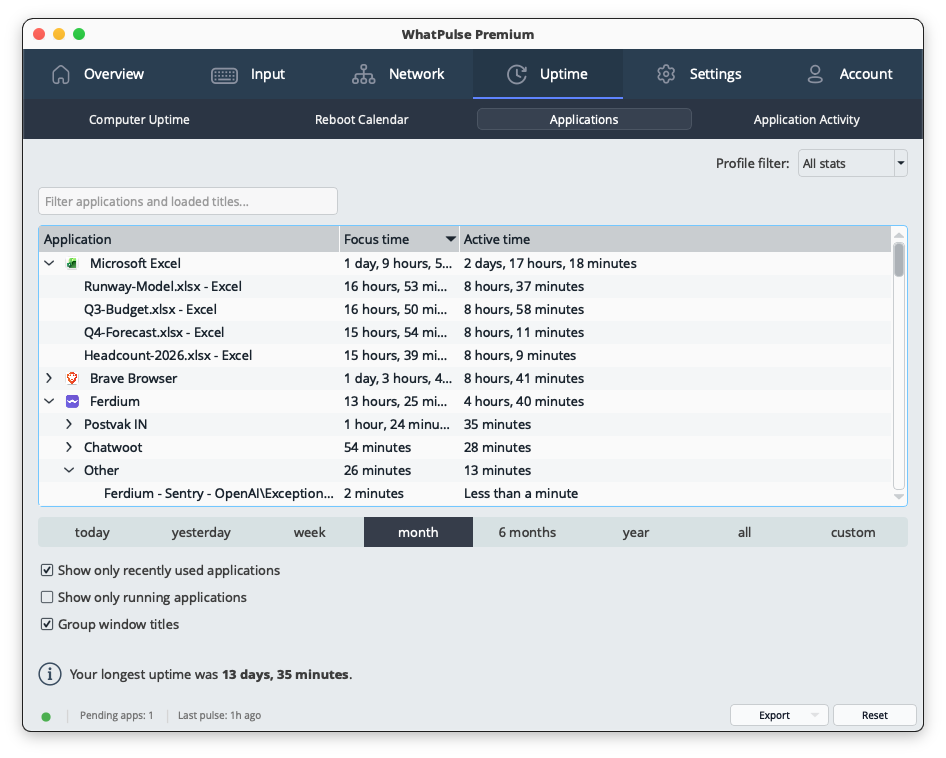
Window title privacy
Because titles can be personal, there is a full privacy layer. Turn off title tracking for specific apps (their uptime still counts), or add words and patterns to hide sensitive titles across every app. Three ready-made filters are included for emails, credit card numbers, and login details in web addresses. Titles from incognito and private windows are always hidden.
Group window titles into projects and workspaces
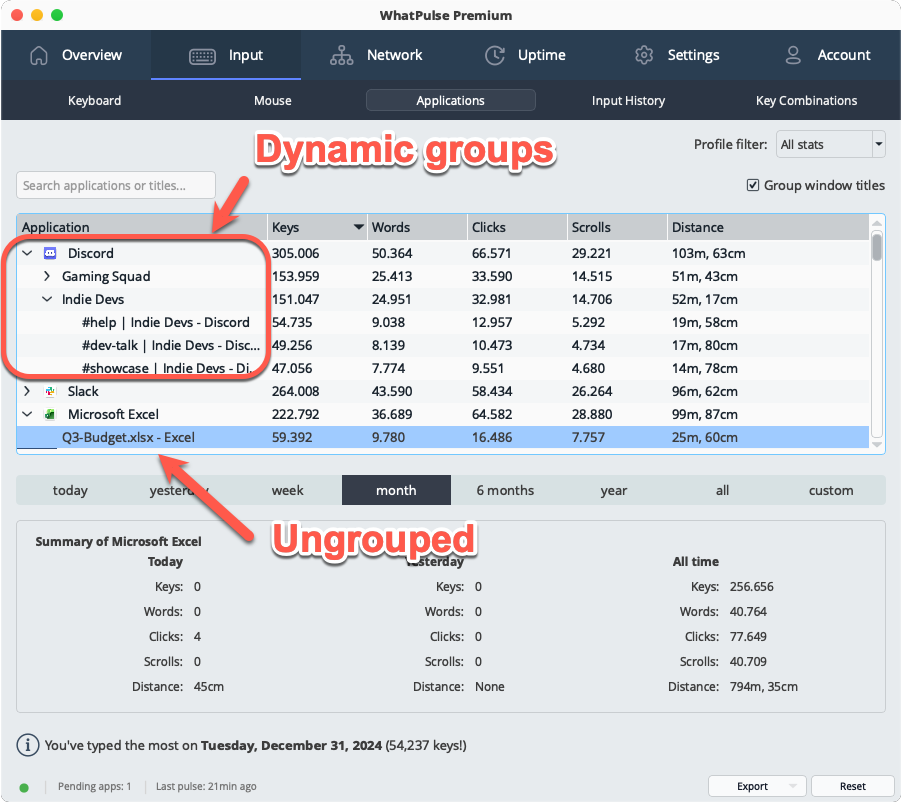
Long lists of per-title rows fold into meaningful groups: VS Code workspaces, IDE projects, Outlook folders, and similar. Grouping is computed in real time on Uptime and Input > Applications, with a single toggle on each page. Search stays flat so a matching title always shows up.
Redesigned tray popup
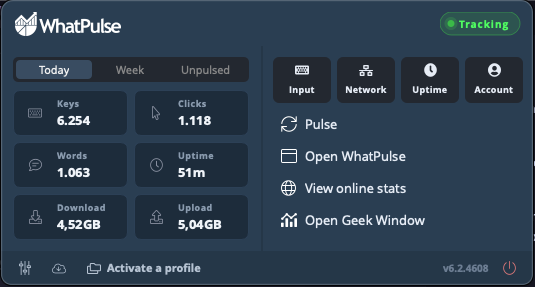
The tray menu is now a compact dashboard. A stats grid shows your Keys, Clicks, Words, Uptime, Download, and Upload, with a Today / Week / Unpulsed switch. Everything you had before is still there - Pulse, open WhatPulse, view your online stats, the Geek Window, and profile switching - just laid out to read at a glance.
Pulsar - a new geek window style
A Bongo Cat inspired desktop avatar that bounces on your keystrokes and clicks, falls asleep when you stop typing, celebrates after a successful pulse, and shows a small stats line underneath. You can also swap in your own artwork with custom avatar packs. Switch between the classic geek window and Pulsar under Settings > Geek Window.
More in this release
- A cleaner Settings screen. The exclusion and list screens throughout Settings now share one consistent design - app exclusions are a single list with a type picker, and network interfaces, Web Insights exclusions, window title filters, profiles, and milestones all use the same tidy, searchable table.
- See your update install. User-initiated updates now show a small progress window with a status line and progress bar, from download through install to restart. Automatic background updates stay silent, as they should.
- Correct keyboard heatmaps on non-QWERTY layouts. Layouts like AZERTY, QWERTZ, Dvorak, and Colemak now light up the right keys on both macOS and Windows, counted and drawn by the letter you actually type, with better auto-detection of punctuation-position letters, dead keys, and the number row. (QWERTY users are unaffected; the macOS change is forward-only.)
- Apps that never reached your online stats. Fixed apps - often newer ones - never appearing in your online profile despite being tracked locally. This sometimes happened when there are a lot of apps.
- Closing WhatPulse is now smoother and more reliable - sometimes the app would hang for a second or two, sometimes crashing on exit.
- Fixed stats silently freezing after a laptop woke from sleep: if your Wi-Fi adapter took a few seconds to reconnect, monitoring could stay stopped while the clock kept ticking. WhatPulse now keeps retrying until your connection is back.
- Fixed the Uptime page not showing new data on the "All" time period when the window was left open past midnight.
- The Input > Key combinations table now grows with the window instead of stopping at a fixed height.
- The milestones log no longer grows without bound; it keeps the last 100 records.
- WhatPulse is now available in Serbian, in both Cyrillic and Latin scripts (Settings > General > Language).
- Linux: fixed a crash that could happen when input devices (keyboards, mice, USB dongles) were unplugged, suspended, or disconnected, and a separate crash that hit every few hours of idle time as an internal watchdog slowly ran out of system resources.
- Linux builds now ship on Qt 6.9, bringing the Linux version up to date with the latest framework release.
Create and sync profiles across your computers
No more manually recreating profiles on every computer. Create them on the website and the WhatPulse desktop apps will automatically sync them.
Create once, track your time towards your Profiles on every computer you have.
WhatPulse 6.2.2
There were some leftover issues in v6.2.1 around the mouse heat map that v6.2.2 addresses:
-
Windows: Mouse heatmap attribution on secondary monitors: Clicks on secondary monitors now appear on the correct monitor in the heatmap instead of all piling onto the primary. Whether you were affected, depends on the display driver stack. Most commonly affected setups include virtual display drivers (DisplayLink docks, Spacedesk, parsec), HDR or DisplayPort MST chains, multi-GPU laptops, or KVM passthroughs.
-
Windows: Click and scroll tracking inside RDP sessions for Premium users: Premium users running WhatPulse on a Windows machine they're connected to over Remote Desktop now have their clicks and scrolls counted again. A 6.2 anti-cheat tightening was incorrectly catching legitimate RDP-delivered mouse input alongside injected input. Keystroke and mouse distance counts were unaffected.
WhatPulse 6.2.1
A focused follow-up to 6.2 with mouse heatmap fixes across all platforms, faster heatmap rendering on installs with long history, and a handful of smaller polish items.
Mouse heatmap fixes
- macOS: clicks on non-primary monitors are now placed correctly. Setups with mismatched sizes, vertical offsets, or monitors stacked above/below the primary previously had heatmap data shifted or missing.
- Windows: clicks on monitors hot-plugged after WhatPulse started are no longer silently dropped. The display list now self-heals when a new monitor is detected.
- Fixed the heatmap occasionally going blank or sticking on stale data when rapidly switching time periods.
- Heatmap queries are noticeably faster on installs with months of history.
Geek Window
- Total words variable added alongside the other word counters introduced in 6.2.
- The variable dropdown in Settings > Geek Window now lists "Total Words" and "Today Words" so you can pick them like any other counter instead of typing the variable name by hand.
Linux: Flatpak package
- WhatPulse is now available as a Flatpak in addition to the existing AppImage. Flatpak runs in a sandbox, installs and updates through your distro's software center or Flathub, and works the same way across every Linux distribution — handy if your distro doesn't play well with AppImages or if you prefer managing apps through a package manager.
Other
- Status pills now have a subtle hover effect on inactive items so it's clearer they can be clicked.
Safari support for Web Insights
Safari support has arrived for Web Insights!
You can now track your website usage in Safari, including active time, keyboard activity, clicks, and more. To enable Safari support, download the new “WhatPulse Web Insights” companion app from the downloads page and install the Safari extension.
There's a walk-through in the Help Center, showing how to install it.

Release notes
What's new with WhatPulse? See the latest updates and improvements.