Focus fragmentation
When focus periods are short and broken up across the day.
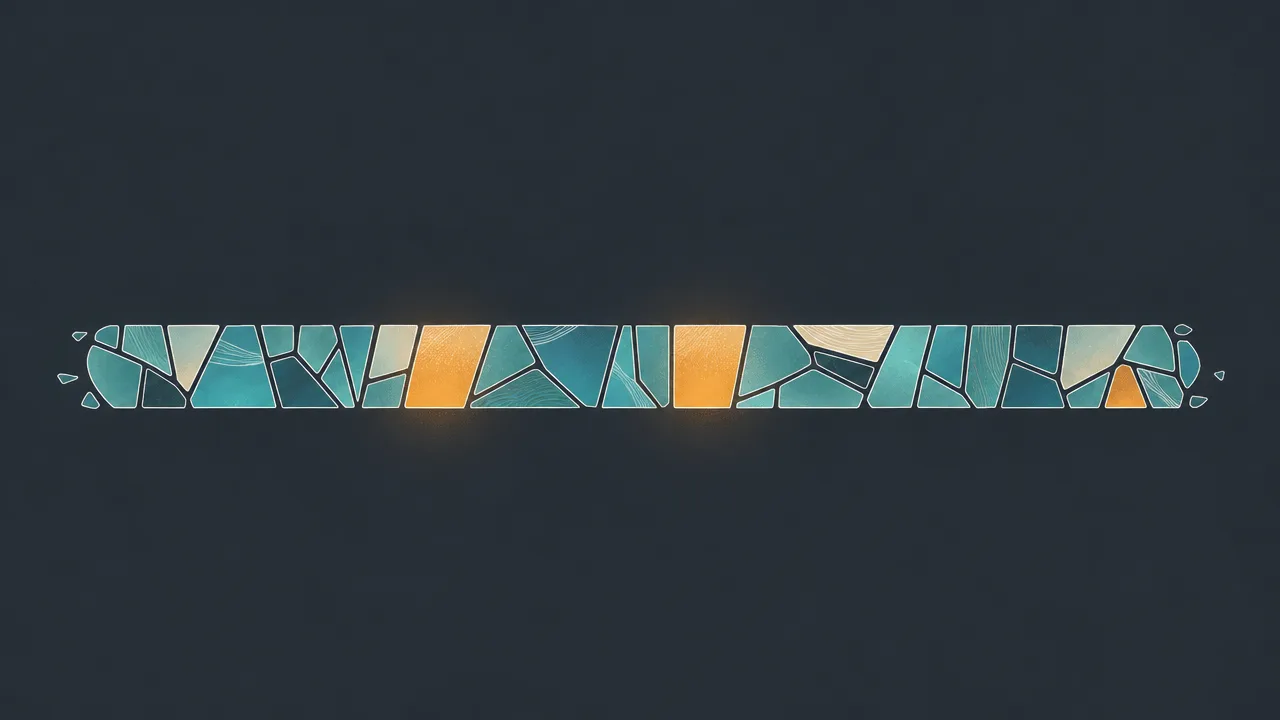
Focus fragmentation describes the shape of a working day in which sustained focus is hard to find. Instead of a handful of long, uninterrupted blocks, the day consists of many short ones, separated by switches, messages, meetings, and idle gaps. The total active time on the computer can stay the same, but the structure of that time is what changes, and the structure is what matters for cognitively demanding work.
This page covers what focus fragmentation is, how it is measured, what the published research says about how common it has become, and how to recognise it in your own data. It is a counterpoint to long focus blocks, the unfragmented shape that deep work, writing, debugging, and creative problem-solving tend to require.
What is focus fragmentation?
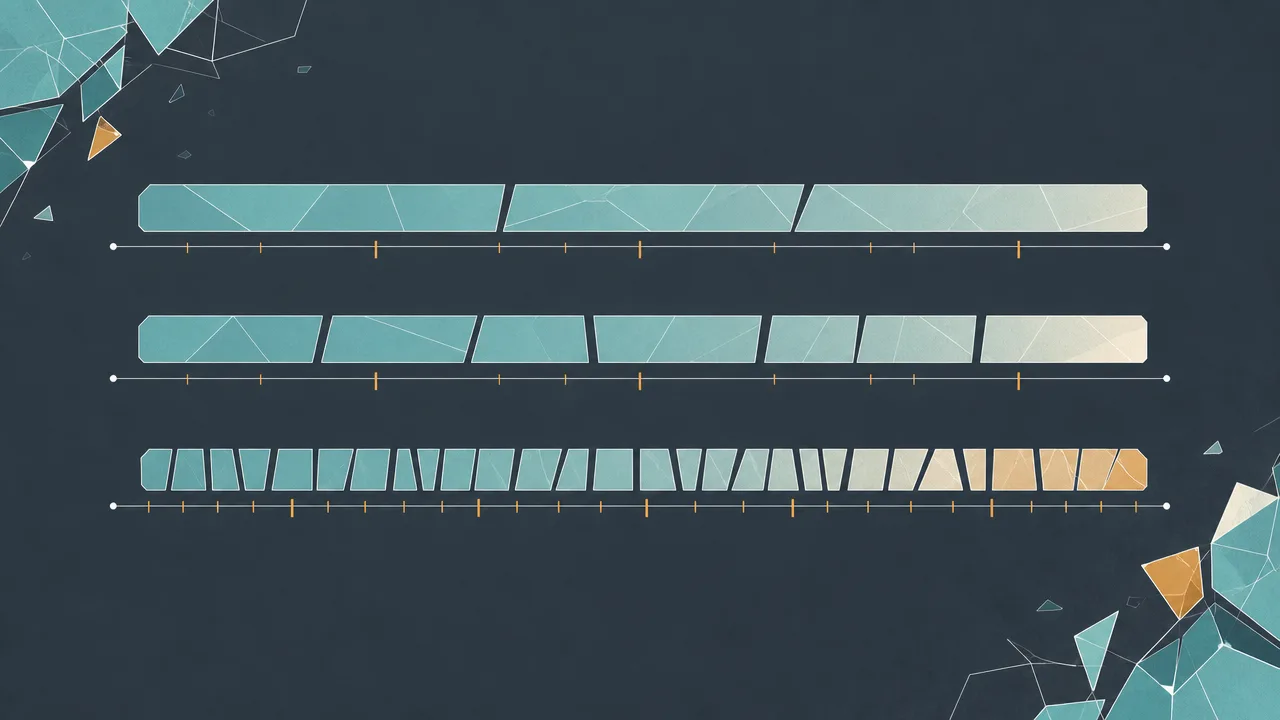
Focus fragmentation is a pattern, not a single number. It refers to the tendency of focus time to arrive in small, frequent chunks rather than long, infrequent ones. Two people can record an identical six hours of active time in a day, yet experience very different days: one assembled from a few hour-long blocks, the other from dozens of two to ten minute slivers. The second day is fragmented.
The distinction sits a layer above raw activity. Active time measures whether the keyboard and mouse are being used. Focus time measures how much of that activity is continuous on a single application or task. Focus fragmentation describes how that continuous time is distributed: many short pieces, a few long ones, or some mix in between. It is, in effect, a measure of the day's shape rather than its volume.
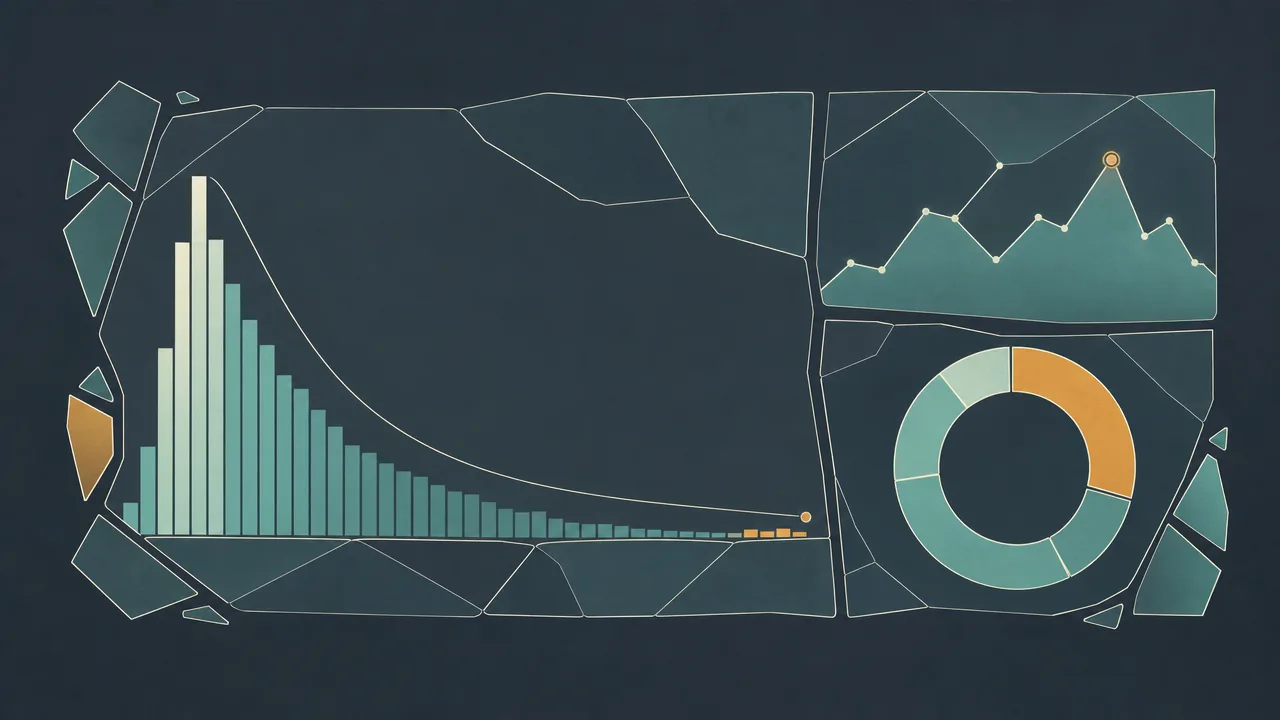
A useful way to picture it is the difference between a histogram with a long tail and one without. An unfragmented day produces a distribution of focus blocks with at least a handful of long ones. A fragmented day flattens that distribution toward the short end, and the cognitively demanding work that needs the long blocks stops fitting anywhere in the day.
Why does focus fragmentation matter?
Most knowledge work is not uniform. Reading email, replying on chat, and updating tickets fit comfortably into short blocks. Writing a design document, debugging an unfamiliar system, or thinking through a strategic question does not. Those tasks require an extended ramp-up, and every interruption costs both the time of the switch and the time needed to re-establish concentration afterwards.
Sophie Leroy's 2009 work on attention residue showed that part of the mind stays on the previous task after a switch, reducing performance on the next one. When a day is fragmented, those transitions stack. The average quality of focus across the day drops even when the active-time total is unchanged. Gloria Mark's research similarly found that recovering full concentration after an interruption can take far longer than the interruption itself, with one widely cited figure of roughly twenty-three minutes for full re-engagement.
The pattern also has a self-perception cost. A fragmented day tends to feel busy without feeling productive. The hours pass, the inbox empties, and the harder items on the list remain untouched. Over weeks and months that mismatch shows up as frustration, drift on long-running projects, and a sense that nothing important is moving, even when activity levels are high.
How is focus fragmentation measured?
There is no single canonical formula. Most tools that try to measure focus fragmentation lean on a small family of derived numbers. The first step is to define a focus block: a continuous run of active time on one application or task, ended either by a switch to a different application or by an idle gap longer than a chosen threshold. Once blocks are defined, the day's distribution of block lengths becomes the raw material.
The most common derived measures include:
- Focus-block distribution: the histogram of all focus-block lengths in a day, week, or month.
- Mean block length: the average duration of a focus block. Useful as a trend, but skewed by occasional long blocks.
- Median block length: often more representative than the mean for fragmented days, because most blocks are short.
- Longest block per day: the duration of the single longest uninterrupted focus block, a strong proxy for deep-work capacity.
- Count of blocks longer than N minutes: how many blocks cleared a chosen threshold, typically fifteen, thirty, or sixty minutes.
- Share of focus time in long blocks: the proportion of total focus time that came from blocks above a threshold, which captures structure better than count alone.
Different tools weight these measures differently. RescueTime's reports emphasise the longest block of focused computer time per day and the count of blocks past thirty minutes. Worklytics and similar analytics platforms derive fragmentation from calendar and chat metadata as well as application use. Personal trackers like WhatPulse expose the raw focus blocks and leave the choice of summary measure to the user.
Common benchmarks
Benchmarks specifically labelled focus fragmentation are rare. The published research describes the same phenomenon under headings like focus time, attention span, and uninterrupted work, and reading across those sources gives a usable picture.
- RescueTime's longitudinal user data found that roughly forty percent of knowledge workers never accumulate even a single thirty-minute block of continuous, distraction-free computer activity in a workday, and that about seventeen percent fail to reach even fifteen minutes.
- The same dataset placed the average knowledge worker at about one hour and fifty-one minutes of focus work per day, against roughly five and a half hours of total time on devices.
- Gloria Mark's research at UC Irvine, summarised in her 2023 book Attention Span, reported that the average length of attention on any single screen has fallen from about two and a half minutes in 2004 to roughly forty-seven seconds in recent measurements, with a median closer to forty seconds.
- Mark's earlier 2008 work, building on Sophie Leroy's research, popularised the figure that it can take more than twenty-three minutes to fully recover concentration after an interruption.
- Microsoft's Work Trend Index 2025 reported that employees are interrupted roughly every two minutes during core work hours, totalling around 275 interruptions per day across meetings, emails, and chat. Sixty-eight percent said they did not have enough uninterrupted focus time in the workday.
These numbers describe population averages from specific datasets and do not generalise cleanly to every role. The honest use of benchmarks is as a backdrop for personal trends, not a target to optimise toward.
Examples
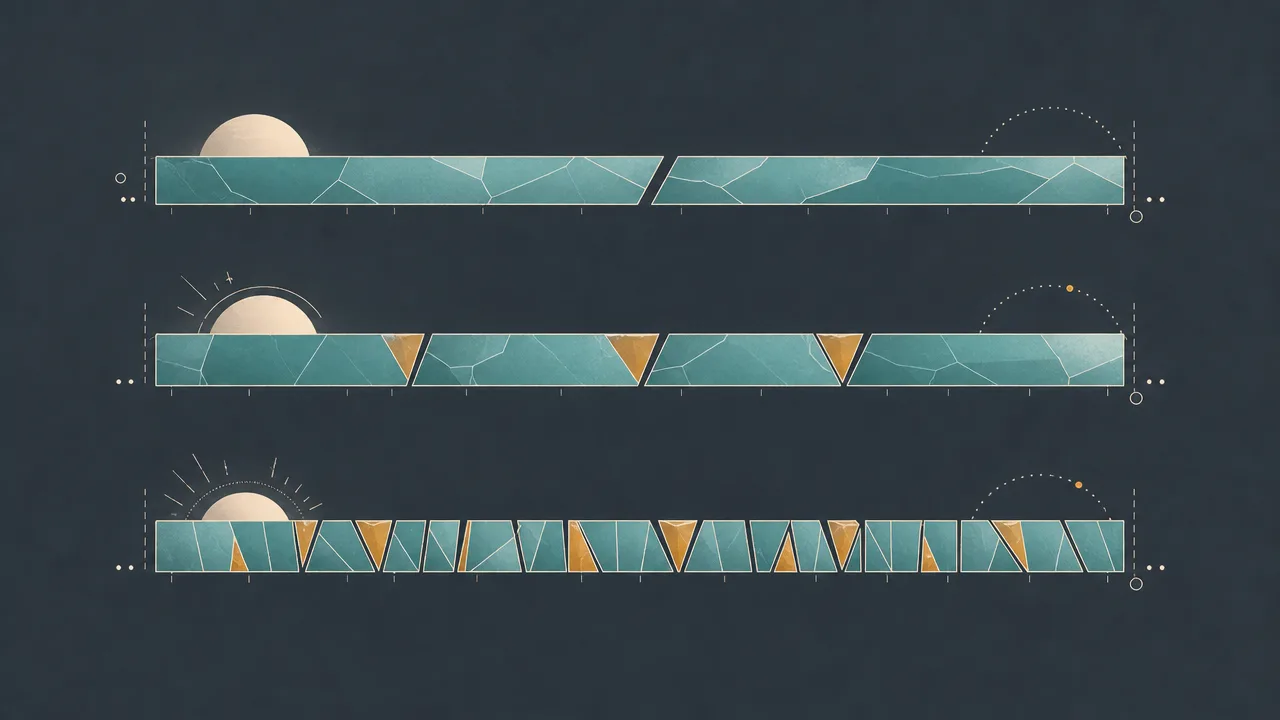
Three short scenarios make the pattern concrete.
A backend engineer ships a tricky migration over a Tuesday morning. They check in on chat at the start of the day, then close it. From 09:30 to 12:00 they alternate between their editor and the terminal without leaving either for more than a minute or two. Their focus-block distribution that morning contains one block of just over two hours and a small handful of short ones. Their longest block per day is high. Their day is unfragmented.
A support lead spends Wednesday triaging tickets. They cycle between the helpdesk, chat, the runbook, and a browser tab every few minutes by design. Active time is high, but no block exceeds eight minutes. Their focus-block distribution is tightly clustered around the short end. This is fragmentation, but it matches the work; the issue is not the pattern itself, only that any deep-work task scheduled into the same day will not fit.
A product manager has a Thursday with three meetings spaced one hour apart. Between meetings they try to write a spec. Each writing window is short, gets interrupted by a calendar reminder fifteen minutes in, and ends with a switch to a pre-meeting browser tab. The spec barely advances. The day records hours of active time and a high switching rate; the longest focus block is twenty-two minutes. The work was fragmented even though no single interruption felt large at the time.
Misconceptions
The first misconception is that fragmentation is always bad. It is not. Open-ended creative work sometimes benefits from short bursts and deliberate breaks, and certain roles such as support, on-call rotations, customer success, and project coordination are structurally built around quick switches. For those roles a fragmented day is the correct shape of the work, not a failure of attention.
A second misconception is that any switching during a focus block ruins it. A brief glance at a notification or a thirty-second chat reply is not the same thing as a full context switch into another task. Most measurement tools sensibly only end a focus block when the foreground application changes for longer than a small grace window or when idle time crosses the threshold. A pulse of distraction does not always equal a structural break.
A third misconception confuses fragmentation with the natural rhythm of attention. Sustained focus is not meant to last for entire days. The Pomodoro technique, ultradian-cycle research, and the working habits of most experienced deep-work practitioners all describe a pattern of intense blocks separated by deliberate rest. The signature of focus fragmentation is not the presence of breaks; it is the absence of the long blocks between them.
Related concepts
Focus fragmentation lives in a tight cluster of related vocabulary. Reading any of them carefully tends to sharpen the others.
- Focus time: continuous active time on a single application or task, the raw material that fragmentation breaks up.
- Deep work: extended focus time spent on cognitively demanding tasks, the use case most damaged by fragmentation.
- Context switching: the act of changing the foreground application or task, the mechanism by which fragmentation accumulates.
- Attention residue: the lingering mental engagement with a previous task after switching, which lowers effective focus on the next one.
- Application switching: a closely related and directly measurable signal that often correlates with fragmentation.
- Workday fragmentation: a broader cousin that also factors in meetings, calls, and time away from the computer.
- Active time: the underlying activity baseline against which fragmentation is computed.
- Notification fatigue: one common driver of fragmentation through repeated interrupt cues.
- Input intensity: useful for separating shallow active periods from deeply engaged ones inside a focus block.
- Activity trends: the long-running view in which fragmentation patterns become visible.
Tracking focus fragmentation
Fragmentation is most usefully tracked at the level of the individual, over weeks rather than minutes. A single fragmented day is noise. A trend in median focus-block length, longest block per day, or share of focus time in blocks longer than thirty minutes carries signal. Looking at those three together is usually enough to characterise the shape of a working week without overfitting to any one measure.
WhatPulse records active time per application locally, which makes it possible to derive focus blocks from raw activity rather than from calendar metadata. That matters because much of what fragments a knowledge worker's day, particularly chat checks, browser flicks, and self-initiated switches, never appears on a calendar. A tracker that only reads calendar entries will systematically underestimate fragmentation; one that watches application focus will not.
The goal of tracking fragmentation is not to push every day toward a single long uninterrupted block. It is to understand which days, weeks, or periods of the year have collapsed into shorter shapes than the work being attempted actually needs, and to use that information when deciding which days to protect and which to leave open to the world.
Frequently asked questions
Is focus fragmentation the same as context switching?
They are related but distinct. Context switching counts how often the active application or task changes. Focus fragmentation describes the resulting shape of the day, specifically how short the remaining focus blocks become and how unevenly they are distributed.
What counts as a focus block?
Most tools define a focus block as a continuous stretch of active time on a single application or category without crossing a switching or idle threshold. A common threshold is fifteen minutes of uninterrupted activity, though some tools use thirty.
Is fragmented focus always a problem?
No. Some roles depend on quick handoffs, short replies, and rapid switching. Fragmentation only becomes a problem when the work being attempted needs sustained attention and the day no longer contains the blocks to support it.
How long should a focus block be to count as deep work?
Cal Newport and others typically describe deep work sessions as lasting between sixty and ninety minutes at a minimum, with experienced practitioners sustaining several such sessions per day. Anything shorter is usually classified as focused work rather than deep work.
Can a fragmented day still feel productive?
Yes, especially when the work consists of small, independent tasks. The mismatch appears when the day feels busy but the harder, more cognitively demanding tasks are never finished, which is a common signature of focus fragmentation.
How does fragmentation relate to attention residue?
Each switch leaves attention residue on the previous task, meaning the next focus block starts at a lower effective concentration. Fragmented days stack many of these transitions, so the average quality of focus across the day drops even when the total active time is unchanged.
Is meeting load the main cause of focus fragmentation?
Meetings are one contributor, but chat messages, email checks, ad hoc calls, and self-initiated switches all play a role. Microsoft and RescueTime data both point to communication tools as a larger source of interruptions than scheduled meetings alone.
Does working longer hours fix fragmentation?
Usually not. Longer hours often add more meetings and messages in proportion, leaving the underlying shape of the day unchanged. Reducing fragmentation generally requires protecting blocks of time rather than extending the day.
Conclusion
Focus fragmentation is the shape of a day, not its size. It records how the available focus time is distributed: whether it arrives in a few long blocks that can sustain demanding work, or in many short ones that cannot. The underlying activity might be identical in both cases, but the work that fits inside each is not.
Read as one trend among several, alongside focus time, context switching, and active time, fragmentation is a useful early warning. It tends to drift in the wrong direction quietly, week over week, until the harder items on the list have nowhere to live. Catching that drift early, and protecting the blocks the work actually needs, is most of what acting on the metric usefully looks like.