Deep work
Extended focus on a single cognitively demanding task.

Deep work is one of the most carefully defined terms in the modern productivity vocabulary, and one of the most casually used. The phrase was popularised by Cal Newport in his 2016 book of the same name, where it describes professional activity performed in a state of distraction-free concentration that pushes cognitive capabilities to their limit. The definition is narrow on purpose. Most of what people call deep work, in Newport's framing, is something else.
This page covers what deep work is, how the idea developed, how computer activity trackers can approximate it, what realistic benchmarks look like, and the concepts that sit next to it in the broader vocabulary of focus.
What is deep work?
Newport defines deep work as professional activity performed in a state of distraction-free concentration that pushes cognitive capabilities to their limit, creates new value, improves skill, and is hard to replicate. He contrasts it with shallow work: non-cognitively demanding, logistical-style tasks that are often performed while distracted and that tend not to create much new value.
The idea did not appear in 2016 from nothing. Newport draws on a long line of historical antecedents. Carl Jung built a stone tower at Bollingen on Lake Zurich and retreated there to write, without electricity or telephone, in long undisturbed stretches. Mihaly Csikszentmihalyi, in his 1990 book Flow, described the subjective experience of complete absorption in a challenging task, in which time, self-consciousness, and effort all recede. Anders Ericsson, whose research underpins Newport's argument and is summarised in his 2016 book Peak, documented how elite performers in music, chess, and sport organise their days around sustained, demanding practice sessions of a few hours at a time.
Deep work, then, is Newport's name for a pattern that already had several partial descriptions. Flow is the subjective side. Deliberate practice is the skill-development side. Deep work is the working description: an external account of what the activity looks like and why it matters professionally.
Why does deep work matter?
Newport's central economic argument is that the ability to do deep work has become both more valuable and more rare. More valuable because complex knowledge work increasingly requires learning hard things quickly and producing at an elite level, both of which depend on sustained concentration. More rare because the working environment for most knowledge workers now actively discourages it: open offices, constant chat, meeting-heavy calendars, and devices designed to fragment attention.
For individuals, the practical case is simpler. The work that produces the largest visible outputs across a year, a finished manuscript, a shipped feature, a passed exam, a designed building, almost always traces back to a relatively small number of hours spent in deep concentration. Time that feels productive but is shallow, like email, status updates, and quick chats, rarely shows up in the same way at year end. Deep work matters because its outputs compound and its absence is hard to compensate for.
For teams and organisations, deep work matters as a design problem. The conditions for it can be protected or destroyed by scheduling, norms, and tooling. Whether a team produces deep work at all depends less on individual willpower than on whether the workday gives anyone an unbroken stretch in which to attempt it.
How is deep work measured or identified?
Deep work is, in the strict sense, defined by an internal state, so no tracker can confirm it directly. What a computer activity tracker can do is detect the conditions that almost always accompany it, and flag time that meets those conditions as a candidate for deep work.
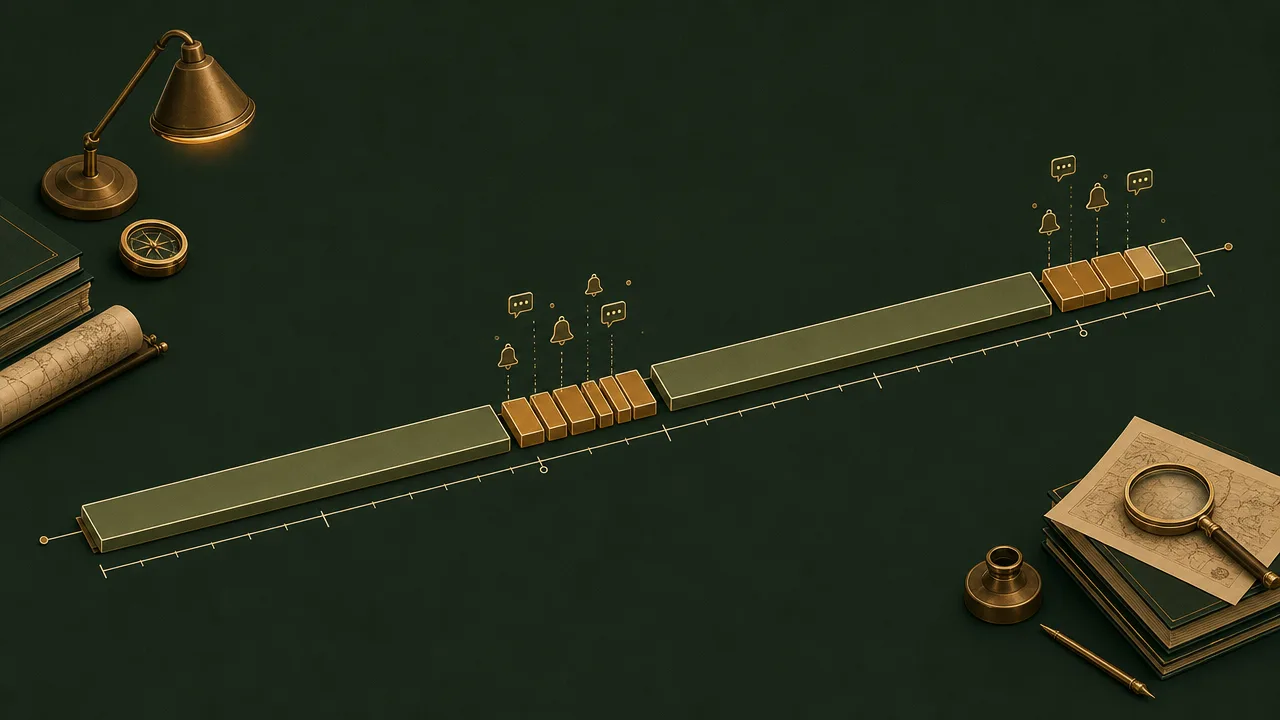
Four signals do most of the work. The first is continuous active time on a single foreground application, typically the editor, document, or design tool in which the actual work is being done. The second is a dwell threshold above which a session is long enough to count as a deep block; common choices in tracking literature sit between forty-five and ninety minutes, with shorter blocks treated as focus rather than deep work. The third is the absence of foreground switches and notification interactions during the block. The fourth, where available, is a categorisation of the foreground application as cognitively demanding, which lets the tracker separate long stretches in a code editor from long stretches in a video player.
The distinction between signal and label is important. A tracker that reports two hours of deep work is really reporting two hours of activity that match the conditions for deep work. Whether the underlying task was cognitively demanding, and whether the person was actually concentrating rather than staring at the screen, can only be confirmed by the person doing it. Treated as a candidate signal, the metric is useful. Treated as a verdict, it overreaches.
Common benchmarks
Hard population-level benchmarks for deep work are scarce, and the published numbers tend to mix several different definitions. With that caveat, a few reference points are commonly cited.
- Newport describes a daily upper bound of roughly three to four hours of deep work for most people, with novices closer to one hour and trained practitioners approaching the upper end. He is explicit that this is an estimate from his own experience and reading rather than a measured population average.
- Anders Ericsson's work on deliberate practice, summarised in Peak (2016), finds that elite performers across domains tend to plateau at around three to four hours of focused practice per day, divided into sessions separated by recovery. The ceiling is consistent enough that Newport uses it as supporting evidence for his own estimate.
- Csikszentmihalyi's Flow (1990) does not give an hours-per-day figure but identifies the conditions for sustained absorption: a clear goal, immediate feedback, and a match between challenge and skill. Sessions that meet these conditions are the ones in which deep work is most likely to occur.
- Gloria Mark's research, summarised in Attention Span (2023), reports that the average duration of attention on a single screen has fallen to under one minute in many measured settings. This is roughly the opposite of deep work, and is one reason structurally protected blocks have become more important rather than less.
- RescueTime has published aggregate user data showing that a large share of knowledge workers do not record any focus block longer than thirty minutes in a typical workday. The exact share varies by dataset; the broad picture, that long uninterrupted blocks are uncommon, is consistent across reports.
These figures should be read as rough orientation rather than targets. The right comparison for any one person is almost always their own trend over weeks and months rather than a published average.

Examples
A few scenarios illustrate how the conditions for deep work appear in practice.
A novelist sits down at 08:00 with the goal of writing the next chapter of a draft. The phone is in another room, the email client is closed, and the only application in the foreground is the writing tool. For the next two and a half hours they move between writing, re-reading, and revising the same document, with no foreground switches and no notifications. A tracker would see one long continuous block on a single application. The novelist would describe it as a morning of deep work.
A surgeon spends the ninety minutes before a complex operation reviewing imaging, planning sequence, and mentally rehearsing the procedure. There is little keyboard or mouse activity, but the attention is completely on one task, and the conditions match deep work almost exactly. A computer-activity tracker would record this as idle time. This is one of the cases where the input-based metric and the underlying reality diverge, and it is worth noting whenever the tracker is treated as a verdict.
A software engineer is debugging a subtle concurrency issue. They spend three hours moving between an editor, a terminal, and a notes file, with the chat client closed and notifications suppressed. The foreground switches frequently between three tools, but all three belong to the same task. A naive tracker would count this as fragmented focus. A more careful one would treat the three applications as a single working set and recognise the period as deep work.
Misconceptions
The most common misunderstanding is that scheduling deep work is the same as doing it. Putting two-hour focus blocks on a calendar protects the conditions, but the blocks themselves are not deep work. A person who fills the slot with email or shallow tasks has scheduled deep work and done shallow work. The distinction is worth keeping clear because the calendar metric is much easier to satisfy than the underlying behaviour.
A second misconception, addressed directly in Newport's book, is that deep work is the natural domain of introverts. It is not. Deep work is a working pattern, defined by attention rather than temperament. Extroverts who structure their day around protected blocks practise it as effectively as anyone else; the style of social recovery between blocks differs, but the work itself does not.
A third misconception is that meetings necessarily preclude deep work. Most do, because they involve frequent topic switching and partial attention. A narrow class of meetings, like a focused design review with one collaborator and no devices, can meet the conditions. The point is to evaluate the actual conditions rather than to apply a blanket rule to anything called a meeting.
Related concepts
Deep work sits in a small network of closely related metrics and ideas. Understanding it well usually means understanding the others.
- Focus time: continuous active time on a single application or task, without the cognitive demand requirement.
- Attention residue: the lingering cognitive trace of a previous task that degrades performance on the current one.
- Context switching: the cost of moving foreground attention between applications or tasks.
- Focus fragmentation: the degree to which a workday is broken into short focus blocks rather than long ones.
- Active time: the underlying input-based signal on which most focus metrics are built.
- Session length: the duration of a single continuous period of active use.
- Workday fragmentation: a broader measure of how meeting load and interruptions break the working day.
- Flow: the subjective state of total absorption that often accompanies deep work.
- Notification fatigue: the cumulative cost of frequent interruption, which is the main structural enemy of deep work.
- Foreground application: the application against which a focus block is attributed.
Tracking deep work
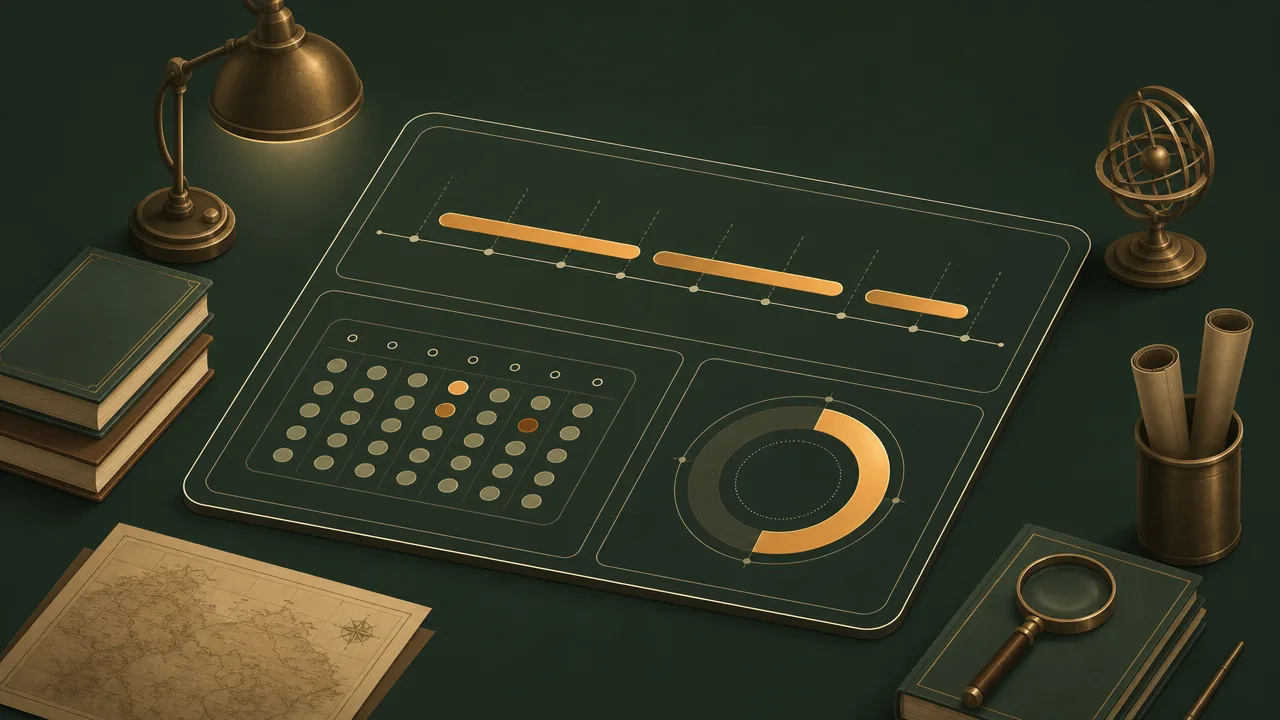
Deep work cannot be measured directly from the outside, but the conditions for it can. A computer activity tracker like WhatPulse records active time against whichever window is in the foreground, which makes it possible to see how often the day contains long continuous blocks on a single working application, free of switches and notification interactions. Those blocks are the candidates worth examining.
The useful question is rarely how many hours of deep work happened on a given day, because the answer depends on a judgement only the person can make. The useful questions are structural. How often does the week contain a block longer than ninety minutes? Which applications appear in those blocks? Which days of the week and times of day tend to produce them? Have those numbers moved over the last quarter? Answers to those questions are what trackers can honestly support.
Used this way, the tracker becomes a way to defend the conditions for deep work rather than to score it. The data exposes patterns, like meeting-heavy mornings, fragmented Tuesdays, or late-afternoon focus windows, that are otherwise easy to miss. What to do about those patterns is a separate decision; having them visible is what makes the decision possible.
Frequently asked questions
Is deep work the same as focus time?
No. Focus time is any continuous period of single-application work without switching. Deep work is the narrower case where that focus is sustained on a cognitively demanding task, usually for longer stretches and with no notifications or interruptions.
How long should a deep work session be?
Cal Newport suggests sessions of roughly 60 to 90 minutes for most people, scaling up with training. Few people sustain more than three to four hours of genuine deep work in a single day, a ceiling that lines up with Anders Ericsson's work on deliberate practice.
Can deep work happen during meetings?
It can, in narrow cases. A focused design review or a deep one-on-one with no devices can qualify. Most meetings do not, because they involve frequent topic switching, partial attention, and parallel chat, all of which break the conditions for deep work.
Is deep work only for introverts?
No. Newport explicitly addresses this. Deep work is a working pattern, not a personality trait. Extroverts who structure their day around protected focus blocks practice it just as effectively as introverts who default to quiet work.
How is deep work different from flow?
Flow, as described by Mihaly Csikszentmihalyi, is a subjective state of total absorption. Deep work is an external description of an activity. The two overlap often, but a person can do deep work without feeling flow, and can feel flow during activities that are not professionally demanding.
Can a tracker really detect deep work?
Not perfectly. A tracker can detect the conditions that usually accompany deep work: long continuous active time on a single application, no foreground switches, no notification interactions. Whether the underlying task was cognitively demanding is something only the person doing it can confirm.
How many hours of deep work per day is realistic?
For most knowledge workers, two to four hours appears to be a sustainable upper bound. Newport reports this range in his own work and cites Ericsson's research on elite performers, who tend to plateau around four hours of deliberate practice per day.
Does deep work require working from home?
No. The requirement is protected attention, not a particular location. Offices with quiet rooms, libraries, and shared spaces with clear focus norms all support deep work. Open-plan environments with constant interruption make it harder, regardless of how the office is described.
Conclusion
Deep work is a precise idea about a narrow thing: professional activity performed in a state of distraction-free concentration on a cognitively demanding task. It is older than the term itself, traced through Jung's tower, Csikszentmihalyi's flow, and Ericsson's deliberate practice, and it remains valuable because the work it produces tends to compound while the work it displaces tends not to.
No tracker can verify the internal state, but the external conditions, long continuous blocks, single foreground application, no notifications, can be observed. Treated as candidate signals rather than as verdicts, those measurements help expose where the conditions for deep work exist in a workday and where they have quietly disappeared. That is usually enough to act on.