Context switching
The cognitive cost of jumping between tasks or applications.
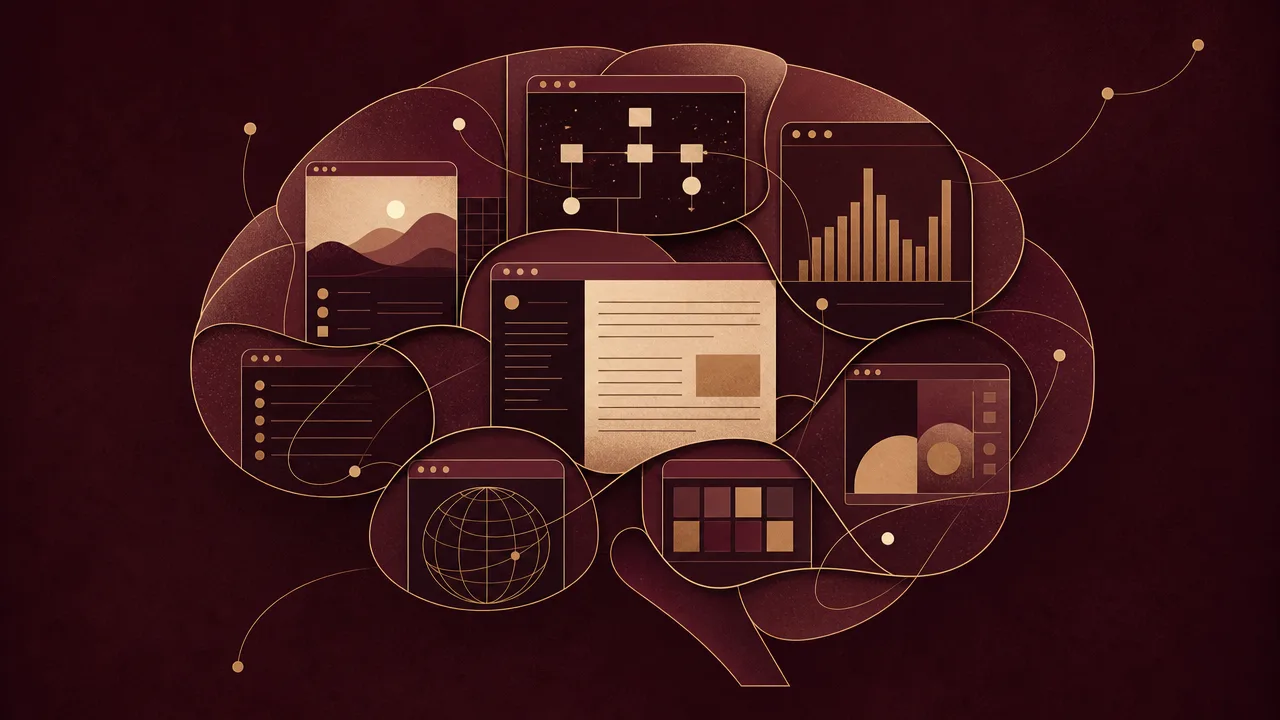
Context switching is the cost of changing what you are working on. Every time attention moves from one task, document, or application to another, the brain has to put the old context away, load the new one, and pay a small penalty in time and accuracy. On a quiet day with two or three switches, the cost is negligible. On a typical knowledge-worker day with hundreds or thousands of switches, the cost compounds into a substantial share of the workday.
This page covers what context switching is, why it matters, how it is measured at the level of computer activity, what the most cited benchmarks say, and where the concept is commonly misunderstood.
What is context switching?
Context switching has two related meanings. In computer science it describes the operating system saving the state of one process and loading another. In cognitive science, which is the sense used here, it describes the same idea applied to human attention: setting down the goals, vocabulary, and working memory of one task in order to take up the goals, vocabulary, and working memory of a different one.
In activity analytics, the term is usually narrowed further to mean a change of foreground application or window during active time. Each time the user brings a new window to the front, scripts running in the background of a tracker can record the switch, attribute the prior focus block to the previous application, and start a new block against the new one. That low-level signal is the empirical basis for almost every published statistic on switching frequency.
The cognitive cost itself is not directly observable. It has to be inferred from behavioural studies, from laboratory task-switching experiments, and from self-report. The computer-activity signal tells you how often the surface context changes; it does not tell you how deeply attention was disrupted by any given change.
Why does context switching matter?
Context switching matters because knowledge work depends on continuity. Writing, coding, design, analysis, and decision-making all rely on holding a small amount of relevant state in working memory: the problem statement, the recent reasoning, the relevant constraints, the next intended step. Each switch flushes some of that state and forces it to be rebuilt the next time the task is resumed.
The rebuild is rarely free. Researcher David Meyer and colleagues, whose work is summarised by the American Psychological Association, found that the time penalty of switching can add up to as much as forty percent of a person's productive time when switches are frequent and the tasks are complex. Those costs are not visible in any one moment, which is part of what makes the concept easy to underestimate.
Beyond raw time, context switching also affects accuracy, stress, and the depth of work that can be done in a given block. A workday made of many short fragments tends to push knowledge work toward shallow, easy-to-resume activities and away from the longer thinking that produces the most valuable output.
How is context switching identified or measured?
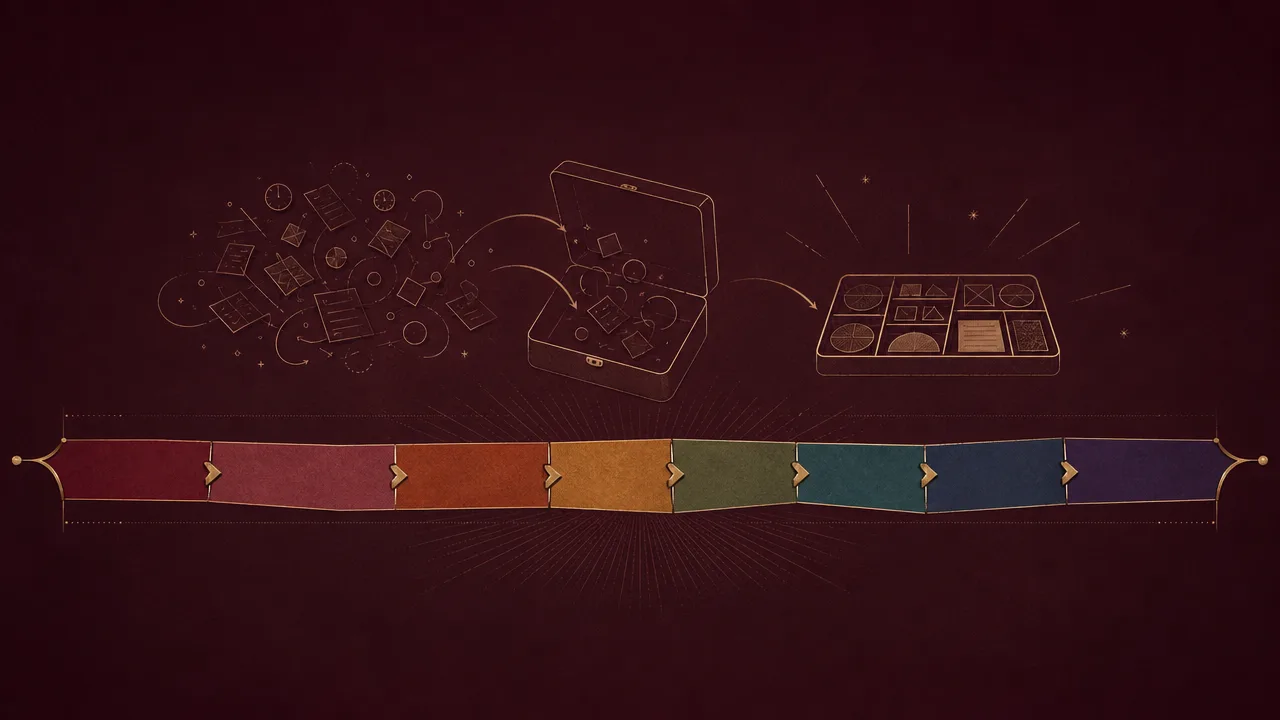
At the level of computer activity, context switching is identified by tracking foreground application changes during periods of active input. Each time the focused window changes, the tracker records a switch event with a timestamp and the source and destination application. From that stream, several useful metrics can be derived: total switches per hour, average focus-block length, the distribution of block lengths, and the composition of the most common switch pairs.
A few methodological choices matter. Very brief switches, often under a few seconds, are usually treated as lookups rather than true context changes; some tools collapse them to avoid inflating the count. Switches that occur during idle time are also normally excluded, because they do not represent active attention movement. And modal helpers, like search overlays or quick-switcher palettes, are sometimes filtered out so that the count reflects deliberate context changes rather than navigation noise.
Laboratory measurement is different. Cognitive scientists use task-switching paradigms where the reaction-time penalty between switch and non-switch trials is recorded directly. That gives a clean estimate of basic switch cost but does not capture the much larger cost of switching between rich, real-world tasks. Most published figures, including the often-cited 23-minute recovery time, come from field studies rather than lab experiments.
Common benchmarks
Several frequently cited reference points appear in the literature on context switching. They vary in methodology and population, so they should be treated as informative rather than precise.
- Gloria Mark and colleagues at UC Irvine reported in "The Cost of Interrupted Work: More Speed and Stress" (2008) that interrupted tasks were resumed, on average, after 23 minutes and 15 seconds, with about two intervening tasks before the original one was picked back up.
- A Harvard Business Review study published in 2022, which examined 137 users across three Fortune 500 companies for up to five weeks, observed roughly 1,200 application toggles per worker per day, with the cumulative reorientation time consuming just under four hours per week.
- A joint Qatalog and Cornell Ellis Idea Lab survey reported that workers took an average of 9.5 minutes to get back into a productive workflow after toggling to a different digital application, with 45% saying the toggling made them less productive.
- Sophie Leroy's 2009 paper "Why is it so hard to do my work? The challenge of attention residue when switching between work tasks" demonstrated that part of cognitive processing remains stuck on the previous task after a switch, measurably reducing performance on the next one.
- Research summarised by the American Psychological Association, drawing on work by David Meyer, Joshua Rubinstein, and Jeffrey Evans, estimates that frequent switching between complex tasks can cost up to 40% of someone's productive time.
Individual variation is large, and a personal baseline almost always tells a more useful story than a population average.
Examples
A few worked examples show how context switching shows up in real activity data.
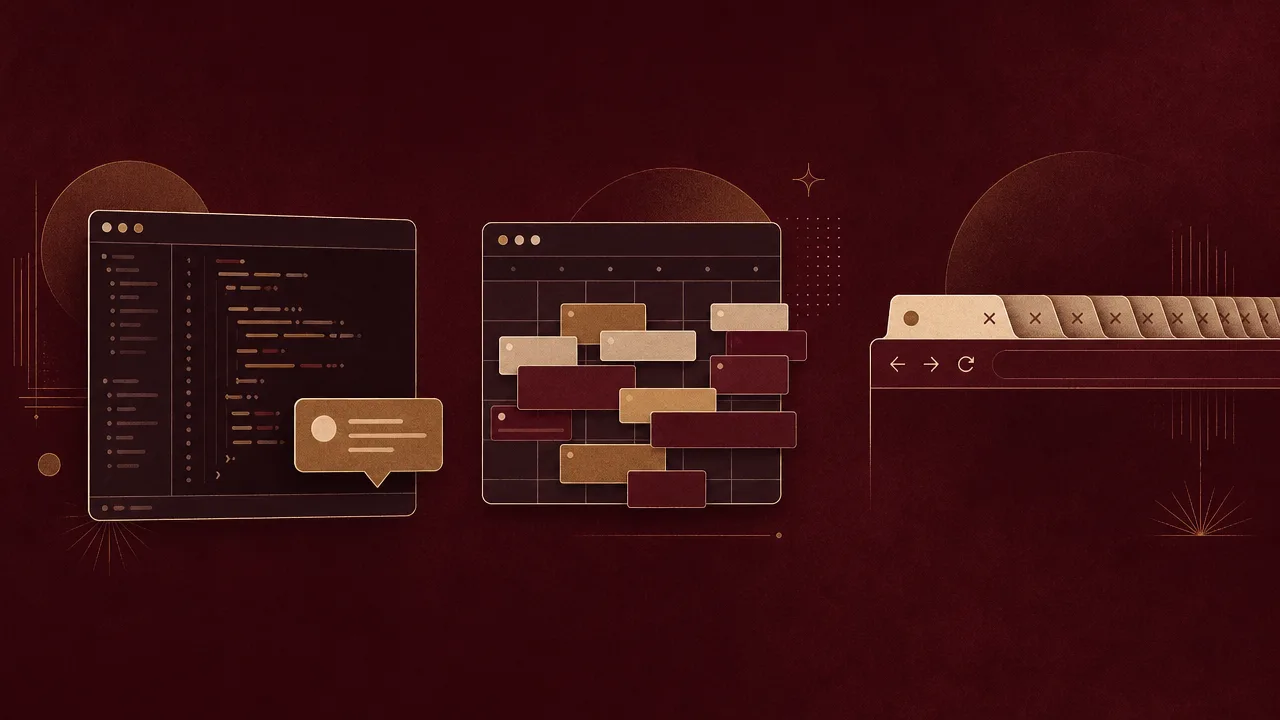
A backend engineer is debugging a tricky data-pipeline bug. They have their editor, a terminal, the cloud console, and the bug tracker open. Each lookup in the cloud console is short, fifteen to forty seconds, and they return to the editor quickly. Switch count is high, but the focus blocks are coherent, all aimed at the same bug. The recorded switching looks alarming, but the work itself is deep.
A marketing manager spends the same hour answering messages in Slack while drafting a campaign brief in a document. Every minute or two they alternate between the two windows. The brief grows slowly, the Slack replies are short and reactive, and the switch count is similar to the engineer's. Here the switching is genuinely costly: each return to the brief requires reloading the half-formed argument, and the residue from Slack keeps pulling attention away.
A student writing a thesis chapter keeps a browser, a PDF reader, and a writing app open. They consult a source, type a paragraph, consult another source, and continue. Switches are frequent but mostly within a single mental task. Focus-block length is short on paper, but the underlying activity is one continuous piece of thinking. The metric reads as fragmented while the work itself is not.

Misconceptions
The most common misconception is that all switching is bad. Quick lookup switches, like glancing at documentation or confirming a calendar slot, are a normal and often necessary part of knowledge work. The problem is not switching itself but high-frequency switching across tasks that compete for working memory, which is a very different pattern.
A second misconception is that multitasking is a real, separate skill. Outside of trivial pairings like walking and talking, the brain does not run two demanding tasks in parallel; it rapidly alternates between them. What people experience as multitasking is, in practice, fast context switching, and it carries the same costs that switching carries everywhere else.
A third misconception is that switch frequency, by itself, is a meaningful measure of focus. Two workers with the same hourly switch count can be doing very different work: one moving inside a single coherent task across several tools, the other actually swapping between unrelated jobs. Without knowing which applications were involved and whether the switches happened inside or across tasks, the raw count is incomplete.
Related concepts
Context switching sits in a tightly connected family of attention and activity concepts. Reading any one of them clearly usually means understanding the others as well.
- Attention residue: the cognitive leftover from a previous task that follows you into the next one.
- Focus time: continuous active time on a single application or task, free of switching.
- Deep work: extended focus time spent on cognitively demanding work, in Cal Newport's framing.
- Focus fragmentation: a pattern of many short focus blocks instead of a few long ones.
- Application switching: the raw event signal that drives most context-switching metrics.
- Workday fragmentation: the broader shape of a day chopped into many disconnected pieces.
- Foreground application: the window that owns focus at any given moment, and against which switches are recorded.
- Active time: the baseline of human input on which switch counting depends.
- Notification fatigue: a leading external trigger for involuntary switches.
- Tab hoarding: a related behaviour that increases the surface area for switching.

Tracking context switching
Because context switching shows up cleanly as foreground application changes, it is one of the more reliably measured patterns in computer-activity tracking. A local tracker like WhatPulse can record each window-focus change against the active-time stream and surface counts, focus-block distributions, and the most common transitions over time. The result is a quantified view of how fragmented or coherent the day really was, independent of how it felt.
As with active time, the value of the metric grows with the length of the trend. A single day of high switching is noise; the same pattern over several weeks is a habit. Comparing personal averages across weeks and months tends to surface useful questions: which application is the most frequent destination, which transitions cluster around mornings or afternoons, which days routinely produce longer focus blocks.
The point of tracking context switching is not to drive the number to zero. Some switching is healthy, and a day with no switching at all probably reflects a very narrow kind of work. The point is to make the cost visible, so that attention can be defended where it actually matters.
Frequently asked questions
Is context switching the same as multitasking?
Roughly, yes. Cognitive scientists generally treat what people call multitasking as rapid context switching, because the brain cannot truly run two demanding tasks in parallel. The label multitasking is largely a misnomer.
How long does it take to recover after a switch?
Gloria Mark's well-known UC Irvine study found that, on average, it took 23 minutes and 15 seconds to return to the original task after an interruption. Recovery time varies widely with task complexity and the depth of the prior focus.
How many times a day do knowledge workers switch?
A Harvard Business Review study published in 2022 observed roughly 1,200 application toggles per worker per day, across 137 users at three Fortune 500 companies. That works out to about one switch every 24 seconds of working time.
Is all context switching harmful?
No. Brief lookup switches, like consulting a reference or checking a calendar, are a normal part of knowledge work. The cost grows sharply when switches are frequent, unfinished, or leave attention residue from a previous task.
What is attention residue?
Sophie Leroy coined the term in 2009 to describe the part of cognitive processing that remains stuck on a previous task after switching. It helps explain why the next task feels harder than it should, even when nothing is technically interrupting it.
Can context switching be measured automatically?
Yes, at the level of application or window changes. Most activity trackers record each foreground change with a timestamp, which lets them count switches per hour and estimate average focus-block length. The deeper cognitive cost has to be inferred.
Does context switching affect error rates?
Research from the American Psychological Association and others suggests that switch costs grow with the complexity of the tasks involved, and that even short interruptions can measurably increase errors on complex cognitive work.
Conclusion
Context switching is the unseen overhead of modern knowledge work. Each switch is small, but switches compound, and the research from Gloria Mark, Sophie Leroy, the HBR toggle study, and the American Psychological Association all points in the same direction: fragmented attention costs measurable time, measurable accuracy, and a non-trivial slice of the productive day.
The useful response is not to eliminate switching, which is neither possible nor desirable. It is to notice the pattern, protect a few longer blocks for the work that requires them, and let the rest of the day absorb the unavoidable churn. A reliable measurement of switching, kept over time, makes that response a little easier to sustain.