Attention residue
The lingering pull of a previous task on the current one.

Attention residue is a small concept with an outsized footprint in how researchers and writers talk about modern work. It names the experience that most knowledge workers know intuitively: starting a new task while the previous one is still echoing in the back of the mind, occupying just enough of the attention budget to leave the new task feeling thinner and slower than it should.
The term comes from Sophie Leroy's 2009 paper, and it has since been picked up by Cal Newport in Deep Work, by the Harvard Business Review, and by a wide range of productivity writers. This page covers what attention residue actually is in the research, what it is not, how it relates to neighbouring concepts like context switching and focus fragmentation, and what an activity tracker can and cannot say about it.
What is attention residue?
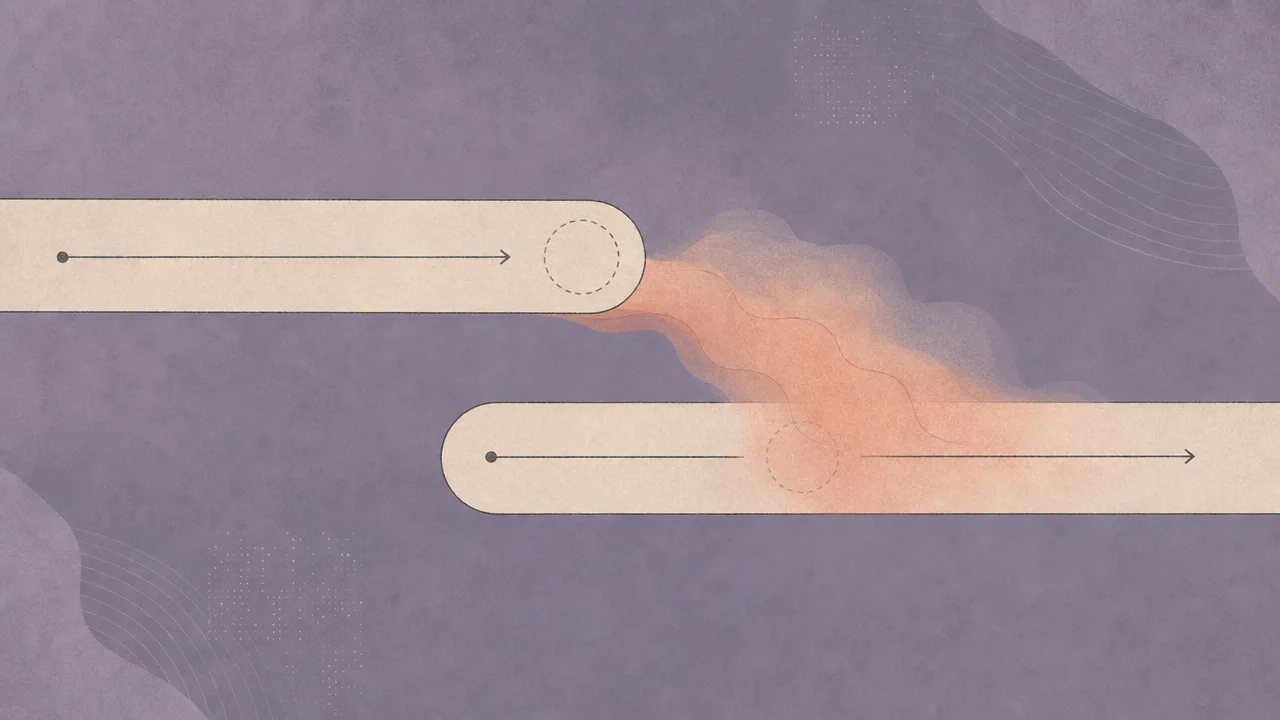
Attention residue is the persistence of cognitive activity about a prior task after a person has stopped working on it and moved on to a new one. The mind has switched in the practical sense, the new task is on the screen and the hands are on the keyboard, but a portion of attention is still tied up with what was just abandoned. Performance on the new task suffers as a result.
Sophie Leroy introduced the term in a 2009 paper in Organizational Behavior and Human Decision Processes, titled "Why is it so hard to do my work? The challenge of attention residue when switching between work tasks." Across two experiments, she showed that participants performed worse on a new task when they had switched to it from an unfinished prior task, and that the size of the effect depended on how psychologically complete the first task felt at the moment of the switch.
The framing matters. Residue is not a measure of distraction in the moment. It is a measure of how much of the previous task is still alive in the mind, quietly competing with the current one for cognitive resources. The switch has happened; the cleanup has not.
Why does attention residue matter?
Modern work is structurally hostile to clean task transitions. Email, chat, ticket systems, and meetings all produce frequent involuntary switches, often before a current task feels finished. Each of those switches is a candidate for attention residue. When the switches are dense, the residue accumulates and the day starts to feel both busy and unproductive at the same time.
For individuals, the concept gives a name to a familiar pattern. A morning that contained three meetings, a handful of Slack threads, and a brief attempt at a writing task can produce a real sense of mental fog without any single event being to blame. Attention residue offers a plausible explanation: each switch left a small tail of unfinished thinking that the next task had to push past.
For teams and organisations, attention residue is one of the more cited justifications for protected focus time, batched communication, and the general push against constant interruption. Cal Newport's Deep Work leans heavily on Leroy's research to argue that uninterrupted blocks are not a luxury but a precondition for cognitively demanding work.
How is attention residue identified?
In Leroy's original work, attention residue was inferred through controlled experiments rather than measured directly. The standard paradigm asked participants to begin a task, switched them to a new task at a defined point, and then assessed performance on the new task. By varying whether the first task felt complete or unfinished, and whether participants were under time pressure, Leroy could isolate how much of the performance drop on the second task was attributable to lingering engagement with the first.
Follow-on work, including Leroy and Glomb's 2018 study in Organization Science on the ready-to-resume technique, refined the paradigm by introducing brief written interventions between the two tasks. Reductions in attention residue showed up as improvements in performance and in self-reported focus on the interrupting task.
Outside the laboratory, attention residue is rarely measured directly. Activity trackers, time tools, and employee analytics platforms cannot see into a person's mind. What they can see is the surface pattern that tends to produce residue: short dwell times in applications, frequent foreground switches, interrupted focus blocks, and inputs that bounce between unrelated contexts. Those patterns are useful proxies, but they are proxies for the conditions that create residue, not for the residue itself.
Common benchmarks
The research literature on attention residue is precise about effects but careful about numbers. A few reference points come up repeatedly and deserve to be quoted carefully.
- Leroy's 2009 experiments demonstrated statistically significant performance drops on a new task when participants switched from an unfinished prior task under time pressure. The paper reports effect sizes within the experimental paradigm; it does not provide a generalisable "minutes of recovery" figure.
- Leroy and Glomb's 2018 follow-up showed that a brief ready-to-resume plan reduced attention residue and improved performance on the interrupting task, with the largest gains for participants anticipating time pressure on the original task.
- Popular coverage often cites a nine to twenty-three minute recovery window after an interruption. Those figures come from separate work, principally Gloria Mark's studies on interruption recovery and an often-quoted Qatalog or HBR article on context switching. They are useful as illustrations of how long switches can hurt, but they should not be presented as direct measurements of attention residue.
- Newport's Deep Work treats Leroy's findings as a directional argument rather than a numeric one. The takeaway in the book is that frequent switching reliably degrades the quality of cognitive output, not that a specific number of minutes is lost per switch.
When precision matters, it is safer to describe attention residue qualitatively, as a measurable effect with sound experimental support, and to attribute specific recovery durations to the studies that actually produced them.

Examples
A few short scenarios show how attention residue tends to surface in ordinary work.
A writer is halfway through a difficult email when a calendar reminder pulls them into a meeting. They close the draft without resolving the awkward middle paragraph and join the call. For the first ten or fifteen minutes of the meeting they listen well enough on the surface, but a quiet background process keeps rehearsing the unfinished sentence. They contribute less than they normally would. The residue is not the meeting; it is the unfinished email still occupying part of their attention.
A product manager is in a planning conversation when they glance at their inbox and read the subject line of a tense customer message. They do not open it. The conversation continues for another twenty minutes, but their contribution becomes more cautious and more clipped, because part of their mind is already drafting a reply to a message they have not yet opened. The switch was incomplete, and that incompleteness is exactly the condition Leroy described.
A developer is fixing a tricky bug when a Slack ping arrives from a colleague. They answer the ping, return to the editor within a minute, and look at the code again. The instructions on the screen are familiar but their working memory of the variable names, the call stack, and the hypothesis they were testing has thinned. They spend several minutes reconstructing what they already knew before the interruption. The residue here runs in both directions: the ping pulled them out, and the half-formed hypothesis pulled them back.
Misconceptions
The most common confusion is to treat attention residue as a synonym for distraction. Distraction is the moment of being pulled away. Residue is the after-effect, the part of the previous task that continues to run in the background once the new task has begun. A workday can be low on distraction in the conventional sense and still produce significant residue if transitions are frequent and unfinished.
A second misconception is that simply stopping a task removes its hold on attention. Leroy's findings point the other way. Residue was lower when participants felt the first task was psychologically complete, and higher when the task was interrupted mid-flight, especially under time pressure. Stopping is not the same as finishing. A short act of mental closure, even just noting where the task stood and what was next, tends to help more than simply switching windows.
A third misconception is that attention residue is the same thing as the much-quoted twenty-three minute recovery figure. That figure comes from interruption-recovery research, not directly from Leroy's residue experiments. The two ideas are related and often cited together, but they describe different measurements and should be sourced separately. Treating them as interchangeable overstates what the residue literature itself claims.
A fourth misconception is that the ready-to-resume technique is an obscure laboratory trick. It is essentially a one-line note: where I am, what I planned to do next. The mechanism is simple, and Leroy and Glomb's results suggest that it works because the written plan offloads the unfinished task from active attention rather than because of anything elaborate in the writing itself.
Related concepts
Attention residue sits in the middle of a family of related ideas about how switching, interruption, and focus interact. A few are particularly close.
- Context switching: the act of moving between tasks or applications, which is the trigger that produces residue.
- Focus time: continuous engaged work on a single task, the conditions under which residue tends to be lowest.
- Deep work: extended focus on cognitively demanding tasks, the regime Newport describes as most damaged by frequent switching.
- Application switching: the surface signal that activity trackers can record and that often correlates with the conditions for residue.
- Notification fatigue: the cumulative drag from frequent interruptions, many of which seed new residue.
- Focus fragmentation: the breaking of focus blocks into short, switched-up pieces, a structural cause of repeated residue.
- Workday fragmentation: the same idea at the scale of a full day, useful for spotting recurring patterns.
- Input intensity: the rate of keyboard and mouse activity, sometimes used as a coarse proxy for engagement during would-be focus blocks.

Tracking attention residue
Attention residue cannot be measured directly by an activity tracker. It is an internal cognitive state, and no keyboard or mouse signal reports on what is still echoing in the back of a person's mind. The honest framing is that trackers measure the conditions that tend to produce residue, not the residue itself.
Those conditions are reasonably well captured by ordinary computer-activity data. Short dwell times in applications, frequent foreground switches, focus blocks that keep being broken before they can settle, and inputs that bounce between unrelated contexts all line up with the experimental setups Leroy used to provoke residue in the laboratory. WhatPulse, like other trackers, records application usage, foreground time, and switches per period. From that data it is possible to spot days and weeks where the structural conditions for residue are heavy, and to compare them against quieter periods.
What the data will not do is tell anyone, in any given moment, how much of the previous task is still active in their attention. The most useful posture for an individual is to use the tracker for the pattern level question, am I structurally setting myself up for residue, and to use techniques like the ready-to-resume note at the moment level, where the actual residue is created and where it can most easily be reduced.
Frequently asked questions
Who coined the term attention residue?
Sophie Leroy, then at the University of Minnesota, introduced the concept in her 2009 paper "Why is it so hard to do my work?" published in Organizational Behavior and Human Decision Processes.
Is attention residue the same as task switching cost?
They overlap but are not identical. Task switching cost is the broader performance penalty incurred when moving between tasks. Attention residue is the specific mechanism Leroy proposed to explain why some of that cost lingers even after the switch is complete.
How long does attention residue last?
Leroy's experiments measured residue effects within minutes of a switch. Popular figures of nine, fifteen, or twenty-three minutes to fully refocus come from separate studies on interruption recovery, not from Leroy's papers directly. Treat those numbers as illustrative rather than precise for residue itself.
Does finishing the prior task eliminate residue?
Leroy found that residue was lower when participants felt a sense of completion on the first task, and higher when the task was left unfinished or interrupted under time pressure. Completion reduces residue more reliably than simply stopping.
What is the ready-to-resume technique?
It is a brief intervention from Leroy and Glomb in which a person, when interrupted, writes a short note about where they were and what they planned to do next. The act of planning the return appears to reduce attention residue and improve performance on the interrupting task.
Can activity trackers measure attention residue directly?
No. Residue is an internal cognitive state and cannot be observed from keyboard and mouse input. Trackers approximate the conditions that produce it, such as frequent application switching, short dwell times, and interrupted focus blocks.
Is attention residue the same as distraction?
Not quite. Distraction is something pulling attention away from the current task. Residue is the previous task still occupying part of attention even after the pull has ended. The two often appear together but describe different things.
Does attention residue affect every task switch?
Leroy's studies suggest the effect is strongest when switching between cognitively demanding, unrelated tasks under time pressure. Switches between closely related tasks, or after a clear sense of completion, tend to produce less residue.
Conclusion
Attention residue is one of the more useful concepts in the modern productivity vocabulary because it puts a precise name on a common experience. Sophie Leroy's 2009 paper, and the follow-on work with Glomb on the ready-to-resume technique, give it experimental grounding. Cal Newport's Deep Work has made it widely known. The popular recovery figures that often travel alongside it are best treated as illustrations from related research rather than direct measurements of residue.
For an activity tracker, the right ambition is honest. Residue itself is invisible to keyboards and mice. The conditions that produce residue, frequent switches, short dwell times, fragmented focus blocks, are not. A tracker that surfaces those patterns clearly, alongside a working understanding of what the research actually says, gives a person enough to act on without overclaiming what the numbers mean.